
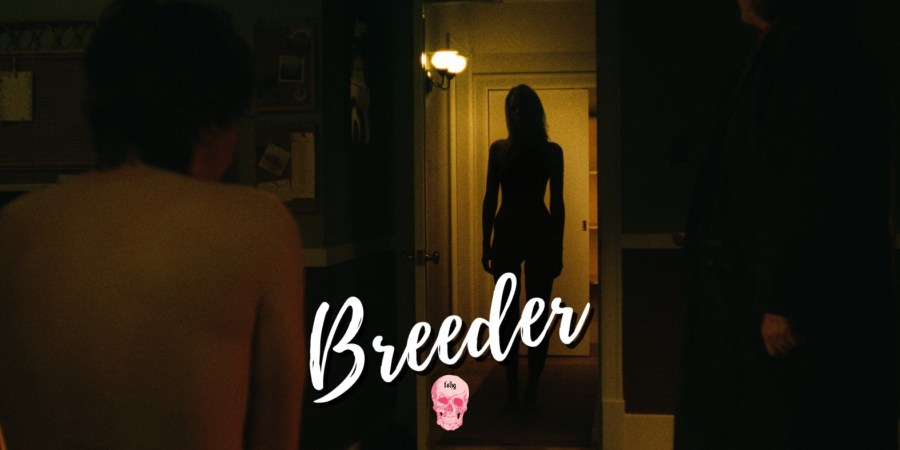
Breeder (2026)
Directed & Written by Alex Goyette
Starring Daniel Doheny, Maddie Phillips, Dot-Marie Jones, & Tanaya Beatty.
Horror
★★★★1/2 (out of ★★★★★)
Alex Goyette’s Breeder focuses on Russell (Daniel Doheny), a broke college student trying to find funding for his research in recognition and “social affirmation.” He and his fiancée Haley (Tanaya Beatty) are exploring adoption options, which doesn’t help with their already fragile finances. A potential investor named Patti (Dot-Marie Jones) reaches out to Russell after getting interested in his research. She says she’ll fund Russell completely if he comes to her dog breeding farm to meet. Russell goes along to the farm where he meets Patti and her daughters. What begins as an evening of dinner and scientific discussion eventually becomes something far more strange and horrific.
Breeder is powerful horror storytelling, as it addresses the ableist and racist ‘science’ of eugenics, and also confronts, as well as subverts, one of horror’s traditional gender setups by placing a male character in a vulnerable situation all too often occupied by female characters. What’s most terrible of all is where Breeder ends up, even after Russell discovers the truth of Patti’s farm and her intentions. By the end, Goyette’s film proves that even seemingly progressive people can be lured into ethical darkness and convinced to turn their backs on their morality if the price tag contains enough zeroes.
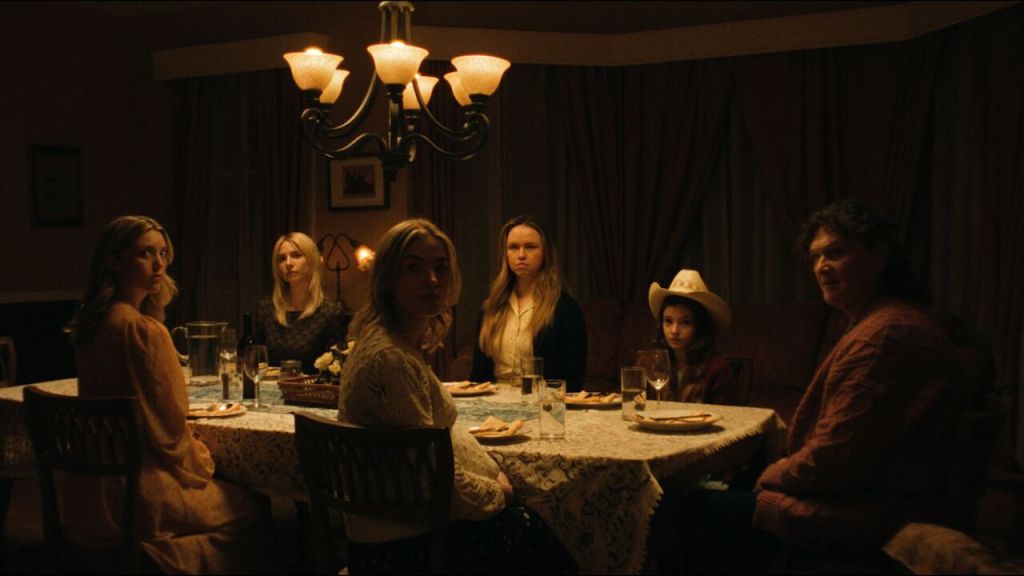
Patti’s breeding farm becomes a microcosm of the dangerous sociopolitical attitudes that are festering in places all around America today, and not just in isolated areas like her farm. During dinner, she very abruptly presents her implicitly white nationalist perspective on breeding, both in animals and humans: “Only certain people should be allowed to reproduce—the best people.” What Breeder deals with very well is the dehumanisation that inherently comes along with eugenics. In one scene, Patti refers to Russell as “the stud” and her own daughter as “the bitch,” terms used for dogs (and other animals) in relation to breeding. The whole premise of Breeder treats both Russell, or any ‘stud,’ and Patti’s daughters like animals, transposing the usual farm accommodations for animals of pens and barns to bedrooms and a house. Russell and the chosen daughter to breed have to stick to a schedule laying out when they fuck. The actual sex is treated like a sterile medical procedure without emotion, akin to a male horse being tricked into mounting a sheath instead of a female horse. Later, Russell rebukes Patti’s dehumanisation by making clear: “Better genes don’t make better people.” What makes the eugenics theme more sensitive in the film is that Russell’s fiancée Haley isn’t white—plus she has fertility issues—so this racial angle heightens Russell’s response. Sadly, this makes a bleak, depressing return at the very end when Haley’s left to live in a brand new world due to the final choice Russell makes.
Breeder works incredibly and uncomfortably well on two levels: on one hand, it’s a horrific tale about contemporary eugenics, hugely significant in a day and age of white nationalism on an increasing rise; on the other, it’s a terrifying tale of gender reversal, as a man is centred in a horror story about forced breeding, generally a story in which women and their bodies are the painful focus. Somewhat similar to the queasy film Calvaire which involves a man being thrust into a sexually vulnerable position typically forced upon women in cinema, Breeder imagines a scenario where a man finds himself being objectified for his body and sexual virility. What’s almost more disturbing in Breeder is what happens in the end. The film’s final scene is such a gut punch that it should leave anybody with genuine human emotion within them winded, and speaks to the fact that men and women view bodily autonomy from a fundamentally, wildly different perspective, no matter their politics.

