

Frogman (2024)
Directed by Anthony Cousins
Written by Cousins & John Karsko
Starring Nathan Tymoshuk, Benny Barrett, Chelsey Grant, Ali Daniels, & Chari Eckmann.
Horror
77 minutes
★★★1/2 (out of ★★★★★)
DISCLAIMER: The following essay contains
SPOILERS!
Turn back, lest ye be spoiled.
Frogman is the tale of Dallas Kyle (Nathan Tymoshuk), a man who once witnessed what he believed to be the Loveland frog while on vacation with his family. He embarks on a trip with a couple friends to go back to Loveland, Ohio and prove what he knows he saw as a boy. When Dallas and his friends arrive in Loveland, they find a location rich in tourism with all manners of ‘Frogman’ merchandise and attractions to indulge. The more Dallas investigates, the more he understands how deeply the Frogman is intertwined with the local population and how seriously the locals take the legend. Beneath Loveland’s cutesy exterior actually lies a terrifying secret and a horrific local tradition.
Most people are playing up the ‘Lovecraftian’ aspects of Frogman (namely a cult worshipping a creature as a god), but there are far more nightmarish qualities than this very surface comparison. Director Anthony Cousins and co-writer John Karsko’s screenplay uses the so-called Lovecraftian aspects to give us a fresh horror film perspective on how true stories about horrifying events are commercialised, packaged, and sold as entertainment even when they have very real, lasting effects on victims/survivors.
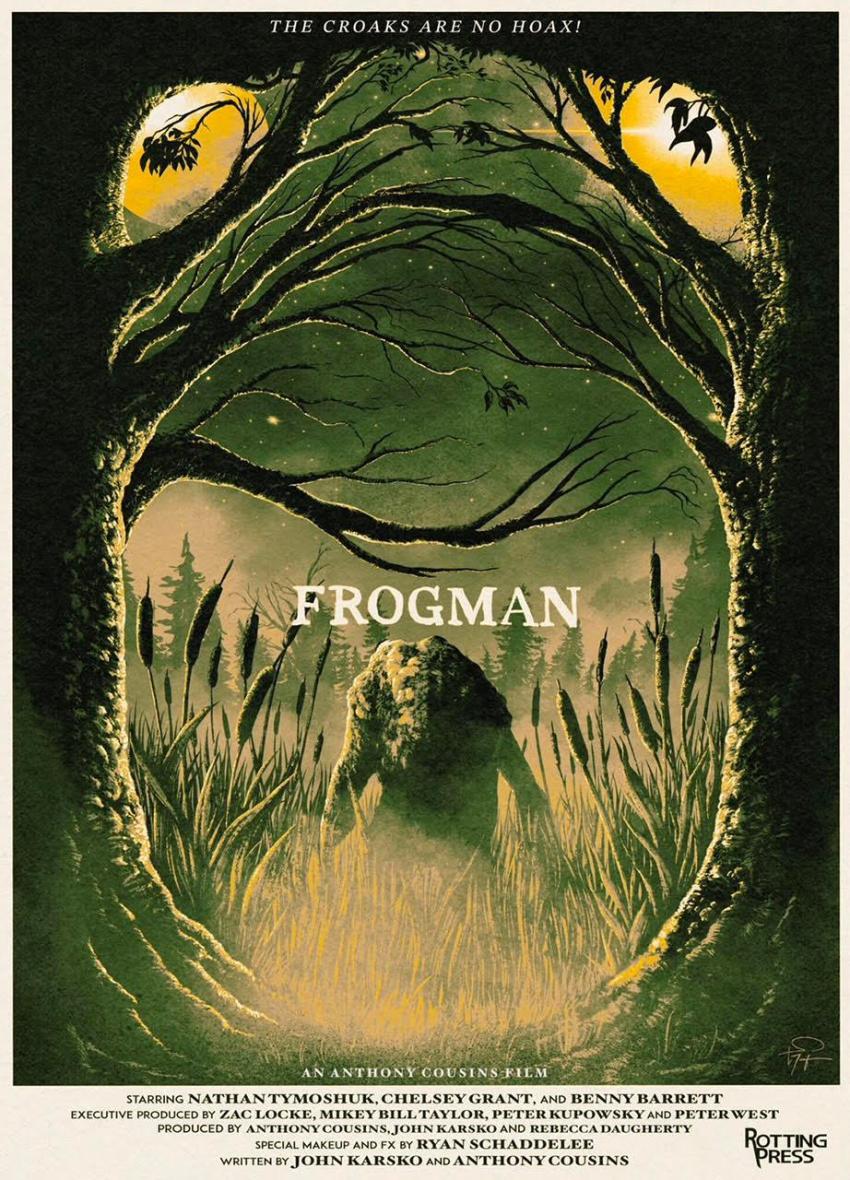 Frogman‘s depiction of Dallas’s obsession with going back to look for the supposed Frogman is similar to the way Blair Witch (2016) depicted the aftermath of a found footage film’s events and the trauma involved for those connected to the story, albeit in a very different way. Dallas is obviously driven by wanting to prove the existence of Frogman after witnessing a strange, frog-like creature back in 1999 which the internet today suggests was a hoax, but we start to find out later that his obsession with that day is connected to other more personal things, too—namely the breakup of his family. There’s a comic aspect to the start of the film when we first see Dallas as a grown man, still caught up with the idea of Frogman, as he’s seen eating Froggy Pebbles. The more we start to see, the more we comprehend that Dallas is kind of frozen in time. A great symbol of this is that Dallas is insistent on not only going back to look for Frogman but also using the same camcorder he originally captured his Frogman footage on in 1999. Dallas is entangled in the past, to the point he wants to use 20-year-old technology to record his journey back into the past. Later, Dallas’s sister paints a clearer picture of her brother’s obsession when she mentions the “last big trip” their family took, obviously before the parents split up, and she mentions that he “always romanticised” the trip. So, yes, a big part of Dallas wanting to go back and find Frogman is that he wants to prove the creature’s existence, especially since the internet doesn’t believe his footage is genuine. Most of all, Dallas wants to go back into his own past in some misguided belief that this will help him recapture proof of the Frogman while also recapturing proof that, once upon a time, he was happy.
One of Frogman‘s biggest strengths is how it depicts the way in which folklore has been turned into a business all across the United States. The Loveland frog is an actual bit of folklore (it started off as Indigenous stories, then, like so many, it was appropriated into good ole fashioned white American folklore) and it’s been milked quite a bit when it comes to local tourism: there’s a Frogman Festival now, there are Frogman trinkets to buy in different places, and so on. In the film, we see all kinds of Frogman t-shirts, chocolate Frogman droppings (just like here in Newfoundland you can find chocolate ‘moose droppings’ to buy in gift shops), Frogman gummies, Frogman flutes, and you can even go try to see Frogman at Frogman Point but you have to pay $5 per vehicle: “Can‘t see Frogman for free, apparently.” Frogman steps it up a bit by portraying the community as much more tightly and sinisterly knit around the local legend. One business owner of a bed and breakfast says “Frogman helps keep me in business” and we later see her taking part in the Frogman cult’s sacrifice preparations. Another local who took a famous photo of Frogman tells Dallas: “A lot of people appreciated all the tourism that it brought in.” Frogman’s existence is twofold because he brings in the business for the frog-related economy, and his identity as a tourist attraction helps bring in new victims for sacrifice; capitalism at its finest and most horrific!
The best aspect of Frogman is the ending, as it illustrates how real, traumatic stories, whether true crime or folklore, have taken a backseat to what has created the trauma itself. Along the way to the final moments, we’re treated to an eerie, disturbing array of images while the Frogman’s cult followers prepare a new sacrifice for their large amphibian master. But the ending is where the film’s most prominent ideas come to the fore, after Dallas’s ordeal is over and he finds himself at a screening of his footage where the crowd seems more excited about the existence of Frogman than they are sad for those who’ve fallen victim to a murderous cult. A great moment right before the end happens when the applause of the waiting audience in the theatre and their voices begin to sound like the previous chants of Frogman’s cult, as if the sounds are all the same, blending together in Dallas’s head. And despite Dallas creating a successful documentary that proves Frogman’s existence, he’s haunted because he might’ve proved the truth but he did so at great cost and traumatic expense. Dallas’s proof is not seen so much as truth, it’s taken as entertainment.
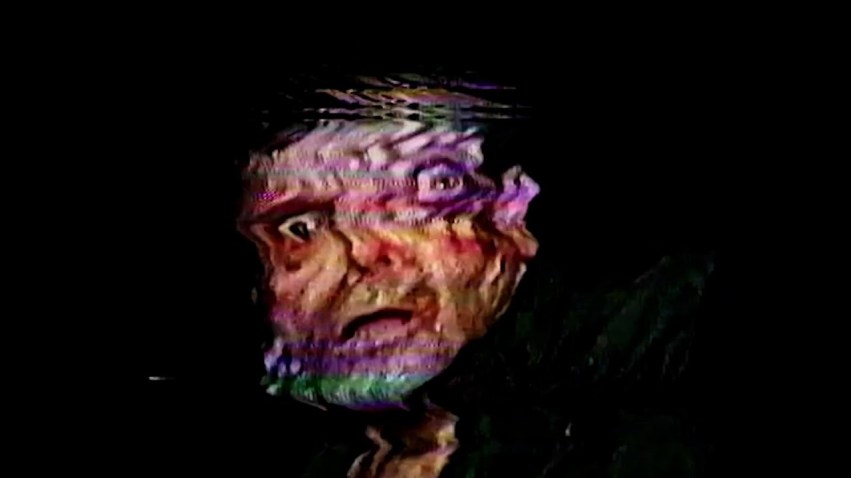 The haunting beauty of Frogman is that it uses folklore to further question the way we consume true crime and become spectators to the traumatic events in peoples lives the same way we watch TV and film as entertainment. Here, the subject is Frogman, but it could’ve easily been a serial killer, a mass shooter, or anything as equally macabre because, in the end, Frogman turns out to be real within the context of the film, and his existence has caused disappearances and murders.
The roar of the crowd at the end for the documentary Frogman is a chilling one, and Dallas recognises that. There are no solemn faces in the crowd at the end of the screening. Everyone’s smiling. There are even families in the crowd with children, and they’re all having a great time. Dallas is being clapped and cheered onto the stage after his documentary is over, but he sits silent in his trauma and the trauma of a dead friend, while all the trauma is nothing but entertaining fodder for the audience. At the same time, the audience’s noise continues through the credits, and we see Dallas pull out the Frogman wand. Perhaps Dallas has become another disciple of the Frogman in the end. His potential use of the wand, presumably on the audience, can be read as symbolic of his traumatic experience becoming the traumatic experience of others through the documentary. Either way, Frogman is a story about how trauma and entertainment have become increasingly merged over the past couple decades in pop culture, to the detriment of all, wrapped up in a story of scary humanoid frog creatures and the people who love them.
 Father Son Holy Gore