
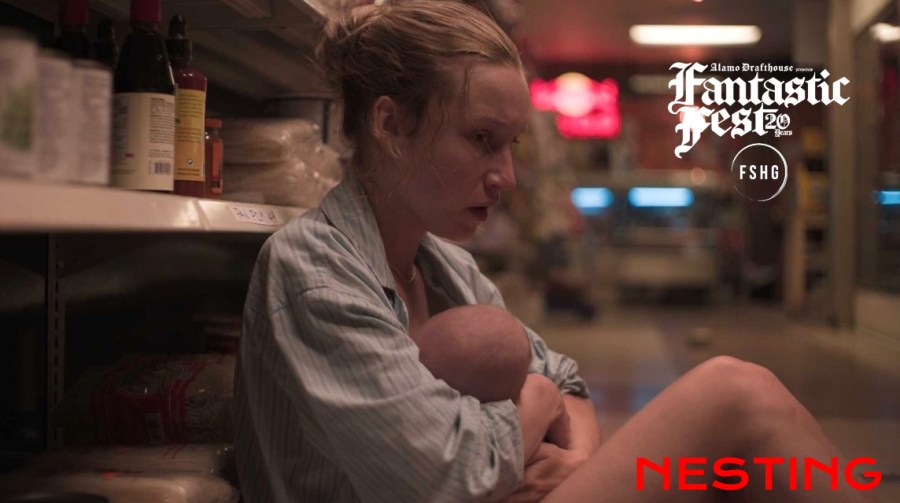
Nesting a.k.a Peau à Peau (2025)
Directed & Written by Chloé Cinq-Mars
Starring Rose-Marie Perreault, Marie Bélanger, Saladin Dellers, Simon Landry-Desy, & Alex Lauzon.
Drama / Thriller
★★★★ (out of ★★★★★)
DISCLAIMER:
The following essay contains
SLIGHT SPOILERS.
Turn back or be spoiled.
Chloé Cinq-Mars’s Nesting was easily one of the heavier films at Fantastic Fest 2025 due to how it tackles mental health with care while also touring through its potential darkness. The film follows new mother Penelope (Rose-Marie Perreault) in the aftermath of going for a walk to calm her crying baby and witnessing an armed robbery which triggers old haunting memories connected to the death of her sister, Charlotte (Marie Bélanger). As Penelope spirals into a bad place, she struggles to stay grounded and take care of her child since her boyfriend isn’t much help, neither for the baby, nor for her psychological state. She does her best to not let the darkness consume her, but things threaten to get much scarier, and she may not be able to stop that from happening all on her own.
Nesting is harrowing at times when the anticipation of something horrific happening becomes so great you can feel the pressure in your bones. Even in the end, things appear to be on the verge of getting better, yet it could all be delusion; it’s never quite as clear as you might hope. The shadowy heart of Nesting is in its confrontation of guilt, and how a guilty mind will eventually unravel into chaos. Penelope’s story can be found in many women whose bodies and minds have been warped by the trauma of childbirth. It’s likewise the story of many people who’ve done their best to bury their guilt but who’ve discovered, sooner or later, that you can never escape your ghosts.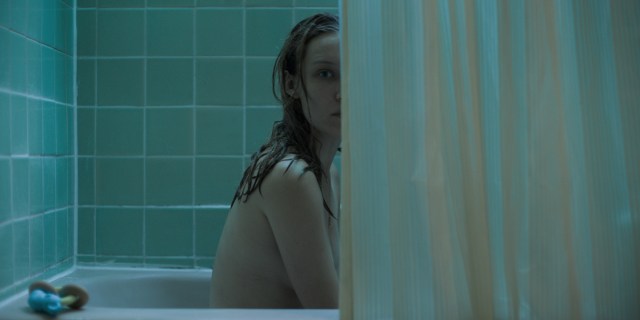 Nesting touches on how a mother’s body, from the time she becomes pregnant to well after childbirth, becomes a kind of societal property controlled by patriarchal forces. The mother’s mind is ignored to no end, whereas the body is preserved at all costs. We see this in an early scene featuring Penelope at the doctor’s office. Penelope makes clear she’s having issues sleeping and is doubting herself as a mother. She’s obviously showing signs of postpartum depression. Yet the doctor, a woman herself, ignores Penelope’s psychological issues. The doctor only cares about Penelope’s body since it must nourish the baby; everything else is of little to no concern. Not long later, we see that everyone has an opinion about the baby, effectively policing and/or criticising Penelope’s body. Women, too, can play a large part in patriarchal control, which we see when Penelope’s boyfriend’s mother complains about her body, stating there’s “not enough milk” for the baby.
One great moment that brings horror into Nesting is when Penelope refers to her child as “My little vampire.” Cinq-Mars’s film doesn’t treat motherhood as sacred. She’s not afraid to question the difficult processes that come with being a mother. Penelope, if only in one instance, views her new baby as a parasite leeching off her. She specifically sees the baby as a parasite draining her power. This thinking leads to uncomfortable moments where the audience is led to worry Penelope may accidentally hurt her child. In one scene, Penelope places a box of rat poison she plans to buy in the stroller next to her baby. Another nervous scene involves Penelope tossing books from a shelf as they loudly fall while the baby is on the floor, and we’re left waiting with near unbearable stress to hear a gruesome crunch. Horror history rears its head when Penelope believes she hears rats in the walls and the way she traces along the wallpaper, given Nesting‘s postpartum depression theme, recalls “The Yellow Wallpaper” by Charlotte Perkins Gilman, paralleling two haunting tales of women grappling with the traumas of mother/womanhood.
Nesting is technically a dramatic thriller, though it’s right at home under the label of horror because of its dark perspective. Chloé Cinq-Mars’s film is reminiscent of Dean Kapsalis’s 2018 film The Swerve in a lot of ways. They each tell different stories, but they also both deal with the common crushing pressures of being women/mothers. The end of Nesting, to some, will seem like the story’s been tied up with a neat little bow after a journey of horrible struggles. But, to me, Penelope’s left in a precarious place by the end of the film where the shadows always remain at the edges, and what the audience sees is not entirely truth. Nesting never dispels the horrors that lurk in Penelope’s damaged mind, appearing to suggest that those horrors could become reality in the blink of an eye should Penelope begin to spiral into darkness again.
 Father Son Holy Gore