
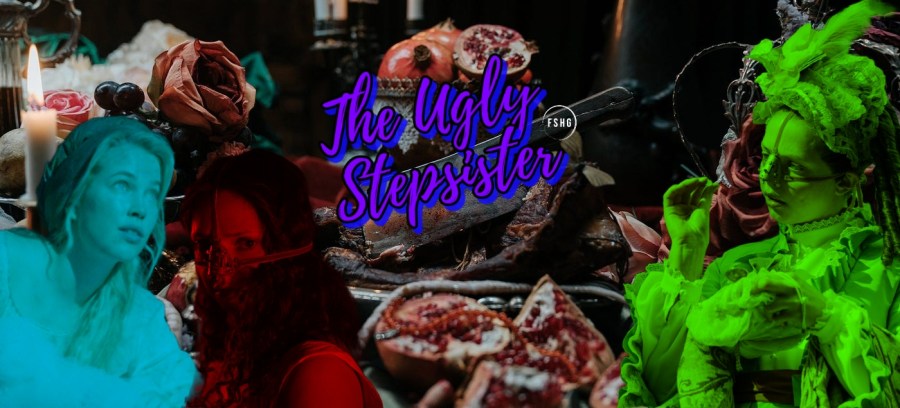
The Ugly Stepsister (2025)
Directed & Written by Emilie Blichfeldt
Starring Lea Myren, Ane Dahl Torp, Thea Sofie Loch Næss, & Flo Fagerli.
Horror
★★★★★ (out of ★★★★★)
Emilie Blichfeldt’s grim body-horror satire The Ugly Stepsister focuses on Elvira (Lea Myren), a nerdy-looking girl living in a cruel world situated temporally somewhere between the 18th and 19th centuries. Elvira’s mother Rebekka (Ane Dahl Torp) marries an old man called Otto (Ralph Carlsson), who almost immediately dies after they move into his stately but decaying home. This leaves Rebekka and her children, Elvira and Alma (Flo Fagerli), as well as Otto’s daughter Agnes (Thea Sofie Loch Næss), with dwindling financial resources. When Prince Julian (Isac Calmroth) and the King throw a ball, Rebekka goes to work on marrying Elvira off to the Prince. This requires money to complete ghastly body modifications on Elvira that only prove to be her family’s undoing.
Fairy and folk tales alike have been vessels through which storytellers have talked about social issues for millennia. They’re timeless vessels, too, as the issues many of them deal with have continued to plague us right up to the current day. One of the oldest issues fairy and folk tales have confronted is the eternal struggle of women in a world dominated by men and harmful male ideas. The Ugly Stepsister—an adaptation of Cinderella, more specifically the version known as Ashputtle recorded by the Brothers Grimm—deals with competition between women and the effects of internalised misogyny, both due to patriarchal control. Blichfeldt tells a folktale in a brutally real fashion to illustrate the physical toll that beauty standards have on female bodies.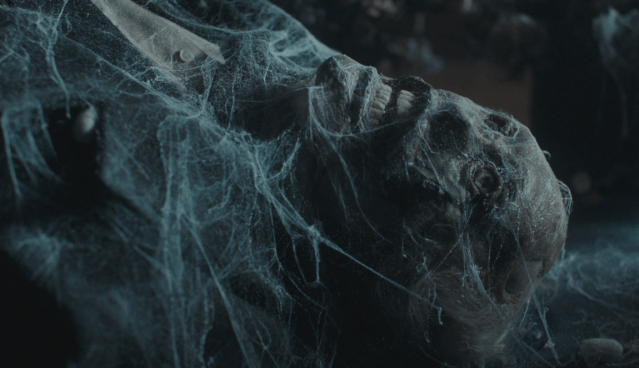 Most of The Ugly Stepsister has to do with the internalised misogyny that so often haunts women who’ve been ruined by patriarchy’s many terrors. Rebekka is the major force of patriarchal control in the story because of how she’s internalised misogyny, believing the only way she and her daughters can exist in the world is by fitting into a strict mould set out by men and their twisted desires, no matter if that means warping their bodies to accomplish it. When Rebekka’s coming to grips with her situation after Otto dies, she cries to Elvira that she’s a “widow with saggy tits and two hopeless daughters.” The only way she sees her or her daughters prospering in life is through giving over one of their bodies to a man in exchange for wealth. The saddest part about The Ugly Stepsister is that all the women and girls in the story live in a world much like our real one, a world in which it wasn’t truly until the mid-to-late-20th century when women were capable of being economically independent without coming from a wealthy bloodline. So Rebekka’s methods, while morally disgusting and tragic for Elvira particularly, are really those of a woman with little other recourse in life except to use the female body as currency.
The Ugly Stepsister is full of body horrors, from Rebekka making Elvira have a primitive nose job to Elvira deciding to swallow tapeworm eggs to lose weight. The most shocking moment of body horror is the culmination of all the film’s bodily horrors when Elvira, determined to fit into a slipper left behind by Agnes after the ball, tries to chop off her toes when she realises her feet are too big to fit it. Elvira fails to complete the task, so her mother finishes it, determined to marry her eldest daughter off even if it means cutting a few pieces of her off, too. One great thing here is how Blichfeldt uses a classic moment from the Cinderella story to show the depraved depths to which patriarchal control and internalised misogyny have sunken Elvira. The slipper moment leads to Agnes and Prince Julian coming together like the classic Cinderella plot, but for Elvira, this moment perfectly captures the hideous results of patriarchal terror upon the female body.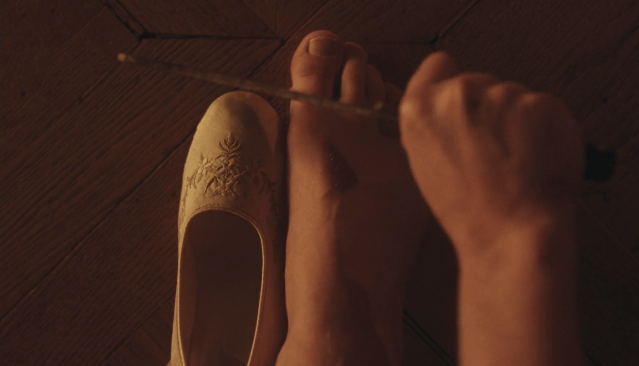
“You’re changing your outside to fit
what you know is on the inside.”
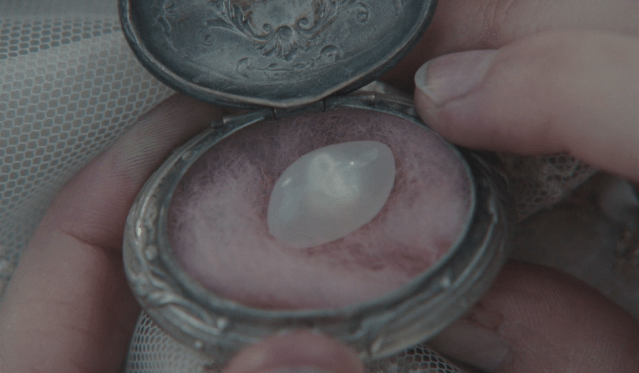 Blichfeldt’s film is a folktale due to its Cinderella/Ashputtle inspiration, and it’s also very Gothic because it’s set in the past yet deals with gender issues that continue to haunt us in the year of its release. The tapeworm egg is an enduring symbol of the many dangerous fad diets throughout history aimed at women. The Victorian era gave rise to the idea of fad dieting due to Victorian society’s growing obsession with smaller female figures; this is when ingesting tapeworms grew in popularity amongst Europeans. From the mid-18th century up until the early 19th century, arsenic pills were also often taken to help with weight loss. You might wish these things were relics of the past, but the digital age has only made it easier for people to obtain dangerous items and for others to spread misinformation about what is/isn’t healthy. Not just that, women’s bodily autonomy continues to be contested and threatened by men in 2025, as well as other women who’ve been poisoned by internalising the misogyny they’ve endured. The Ugly Stepsister is fiction, but, like most folktales before it and the one on which it’s based, it’s a dark mirror of the horror male-dominated societies inflict on women’s minds and their bodies.
 Father Son Holy Gore