

Mārama (2026)
Directed & Written by Taratoa Stappard
Starring Ariāna Osborne, Toby Stephens, Umi Myers, & Errol Shand.
Horror
★★★★1/2 (out of ★★★★★)
DISCLAIMER:
The following essay contains
SIGNIFICANT SPOILERS!
Turn back lest ye be spoiled.
Taratoa Stappard’s Mārama is a haunting story centred on Mary (Ariāna Osborne), an orphaned Māori woman who receives a mysterious letter from a man claiming to know information about her parents. When Mary travels to Yorkshire, England, she arrives at a grand estate in the English moors. She’s greeted by Nathanial Cole (Toby Stephens). He soon offers her the position of governess at his home, in order to teach his niece. Mary accepts, if only to find out more about her past. Unfortunately, the longer Mary stays at the manor, the more terrors she unearths about Cole, as well as what happened to her parents. Stappard has gifted the cinematic world its first glimpse of Māori Gothic, which, like so much of the Gothic, looks back into a painful past. Mārama is exceptionally terrifying and painful due to a focus on the brutal, generational effects of British colonisation on the Māori.
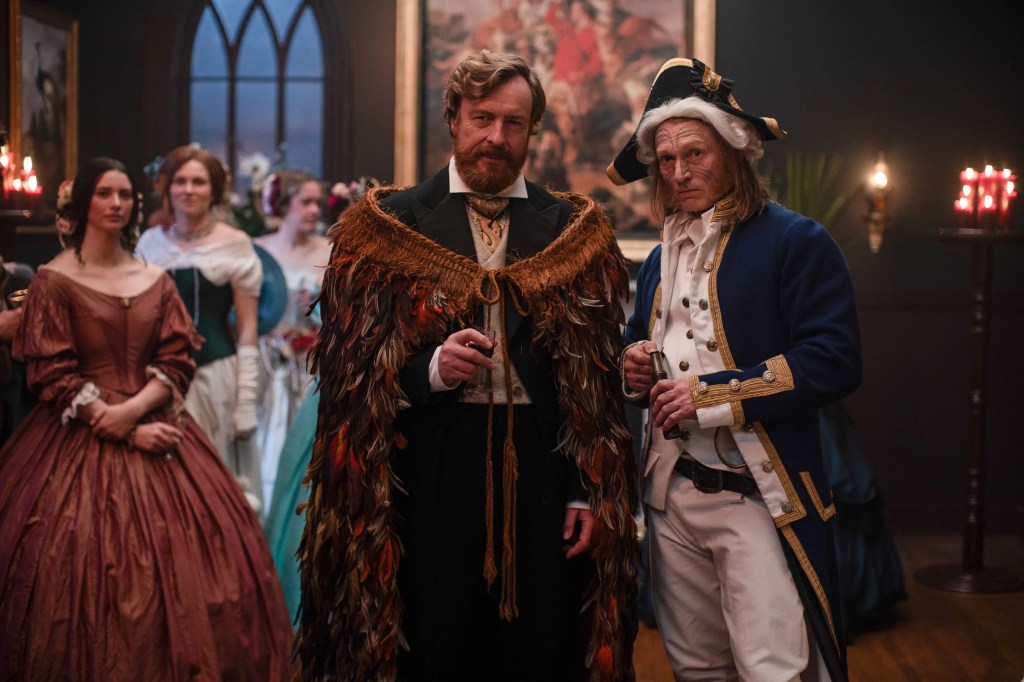
Cole’s entire existence is a celebration of British colonialism, all the worse once his violent, incestuous empire is laid bare by the film’s end. The various paintings that stand out in certain scenes are all colonial images. We see a painting of Captain Cook in The Landing at Tanna [Tana], One of the New Hebrides (1775-1776) by William Hodges depicting Cook as a welcoming, open-armed figure meeting Indigenous people on the shore; a stark contrast from what actually happened. We also see a couple different whale-hunting paintings, such as Whalers of Twofold Bay, New South Wales (1867) by Sir Oswald Brierly, which depicts the bloody violence of whale hunting, one of British colonialism/capitalism’s most lucrative industries. Most nasty is when Cole throws a party and Mary walks into the middle of it just as he’s raising a glass to toast Captain Cook for ‘discovering’ so much.
One of the major effects of colonialism is Indigenous peoples and their cultures being rendered into objects, just as we see Cole treat the Māori in Mārama. Cole warps the idea of the Māori house as ancestor into the idea of the Māori as physical possessions. He builds a secret garden in which he places a wharenui, a traditional communal Māori house that often represents an ancestor of the tribe, yet he fills it with literal death, creating his own personal mausoleum of the Māori women he’s brutalised and murdered. Cole reveals he’s kept the decapitated heads of several Māori women, displaying them like busts on his wall. This also dehumanises the Māori women, treating them not only like objects, but also like animals who’ve been hunted for trophies. Cole’s garden and Māori house are an unsettling image that makes one think of the British Museum and all the stolen/replicated artifacts it houses; a Gothic vision of cultural theft.
Cole’s objectification of the Māori speaks to the overall cultural appropriation Stappard confronts throughout the film. One of Cole’s closest friends, Jack, is a perfect example of cultural appropriation, given the way he’s adorned himself with traditional Māori markings, particularly on his face, how he forcibly pulls Mary into the hongi, a symbolic gesture meant to display unity and respect, and the way he warps a Māori proverb. Jack is adorned with tattoos meant to be tā moko, a sacred Māori tradition done using bone chisels. Each piece of tā moko represents things like ancestry (whakapapa) and more. Jack’s tattoos are purely ornamental. He sees the Māori like objects, in the same way as Cole. Apart from the tattoos, Jack’s first real disrespect of Māori culture is the way he forces the hongi on Mary when they initially meet. In Māori culture, the hongi is a traditional greeting when two people press their foreheads and noses together, meant as a symbolic gesture of unity and mutual respect. But Jack pulls Mary into him; she’s clearly not comfortable. At every turn, Jack violates Māori culture, perverting it for his own amusement. Similarly, a Māori proverb Ka mua, ka muri (or Kia whakatōmuri te haere whakamua) translates roughly to English as “I walk backward into the future, my eyes fixed on my past.” This is meant to convey humility and reverence for ancestors. What’s disturbing is that Jack, who mockingly says he’s “walking backwards into the future” to Mary, isn’t only appropriating yet another piece of Māori culture and their language, he’s repeating words Mary’s heard from her mother in a dream. Far worse is that we’re eventually privy to a flashback scene that shows the evil Jack has had a part in as a coloniser, directly related to Mary’s family. Jack has no reverence for Mary’s ancestors, nor does he have any humility. His twisting of the proverb is perhaps most disturbing of all his cultural appropriation due to the direct link to the violence committed against the Māori, particularly Māori women.
In a couple different ways, Mary, whose real Māori name is Mārama, strikes back at the colonial British heart. The most intense moment of Stappard’s film is when Mārama, fed up watching a bunch of white people in various forms of what’s essentially white Māori drag, yells at the guests of Cole’s party, admonishing them for disrespecting her culture and ancestors. Then, Mārama does a haka. Many white Westerners weren’t familiar with the haka until recently when MP Hana-Rawhiti Maipi-Clarke began and led a haka in New Zealand parliament. In Stappard’s film, Mārama does a form of haka that could be one of a few types, such as a haka to restore self-respect (pātere), or a hatred/venting haka (kaioraora). Regardless of the type and for what purpose it’s meant, witnessing Mārama do a haka is incredibly powerful. While most of Cole’s white partygoers clap as if Mārama was performing for their titillation, Jack recognises the power of Mārama’s haka, appearing haunted by it.
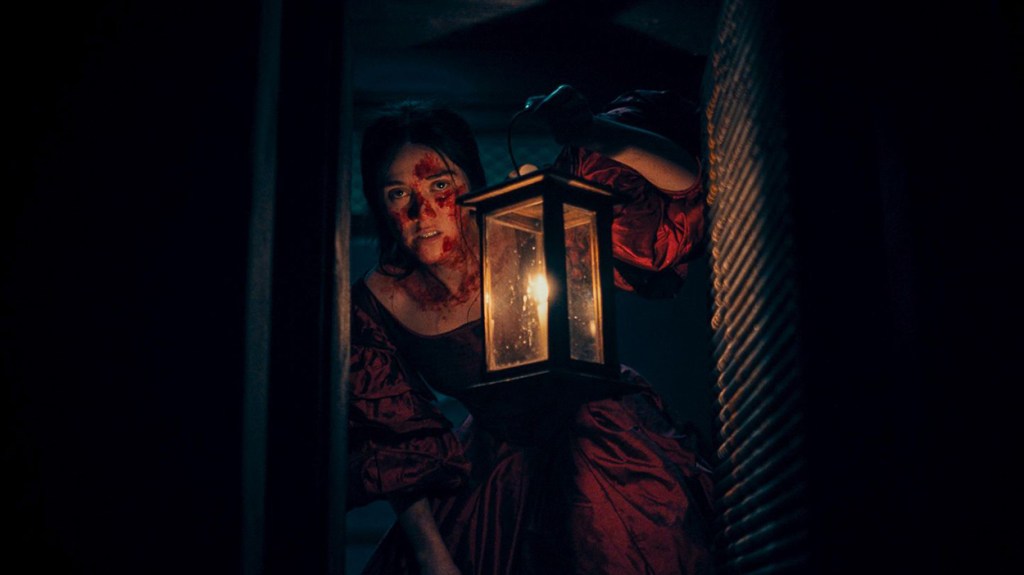
Mārama revisits the bodily horrors of colonisation upon Jack and Cole, especially the latter. When she finally enacts violence against Cole, she uses a head spade, a tool used to cut off a whale’s head by chopping through the vertebrae at the base of the skull and also to cut up other parts of the whale’s body. Just like Cole renders the Māori women’s heads into animalistic trophies, Mārama turns him symbolically into a whale. Earlier in the film, there are two mirrored images: the first is a painting on one of Cole’s manor walls by Alfred John Cooper called Cutting the Blubber Off a Whale on Mohaka Beach (painted sometime between 1860-1865), the other is a nightmare Mārama has featuring a dead whale being stabbed by Cole who’s almost in a hypnotic trance of bloodlust, a living image of Cooper’s painting. When Mārama takes revenge on Cole, she stabs and decapitates him with a head spade exactly like she saw Cole doing to the whale in her nightmare.
The paintings themselves are symbolic of Cole’s fascination with culture and ethnic groups as artifacts or general objects. Cole fetishises the Māori. He calls them “magnificent specimens” as if they’re creatures to be studied. The garden and the replica Māori wharenui are perfect images of colonialism and the dark role of capitalism in the process: the theft of land and resources, as well as the theft (and desecration) of a culture that is then reproduced and stripped of its meaning. Mārama is a devastating gothic horror about how the effects of colonisation linger across generations. All the same, there’s hope within the film, albeit after bloody retribution. In the end, Mārama reclaims her ancestry by returning the murdered Māori women of her bloodline to Aotearoa, as well as by adorning her chin with tā moko. Mārama lingers long and terribly on the horrors of colonialism, yet Stappard never loses sight of the revolutionary power in reclaiming one’s identity from the coloniser.


Pingback: This Week at the Movies (Jul. 10, 2026) – Online Film Critics Society