

Blue Film (2026)
Directed & Written by Elliott Tuttle
Starring Kieron Moore & Reed Birney
Drama
★★ (out of ★★★★★)
DISCLAIMER:
The following essay contains
DISTURBING DISCUSSIONS & SPOILERS!
You’ve been warned.
Elliott Tuttle’s Blue Film is not for the faint of heart. The film centres on Alex (Kieron Moore), a dominant gay man who streams online and fucks in-person under the pseudonym Aaron Eagle. Alex gets paid a huge sum of money to go meet a man in a ski mask who films him while asking increasingly personal questions. Not long after the filming begins, Alex discovers the man in the mask is actually Hank Grant (Reed Birney), a former teacher from grade school who got fired due to an incident at school. Over the course of the evening, Alex and Hank talk about their past and current lives. They also begin to explore their respective perversities. Before the night’s over, they confront themselves and each other in shocking ways.
There are moments where Blue Film heads in the right direction. Unfortunately, it gets lost along the way—lost wandering down a dark path of empathy for a hideous, despicable man. Tuttle’s film contains fascinating moments during which Alex and Hank confront differing perspectives on sexuality, and those moments are brutally honest. But Blue Film lingers at the middle of the road in its haunting discussion about paedophilia. Several reviews have said the film somehow challenges our ideas about sexuality and abuse; makes me think we’ve watched something different. For me, Blue Film briefly gets close to being profound about sexuality, then sinks and becomes mired in a woefully misguided desire for pure empathy in the face of disgusting, immoral acts.
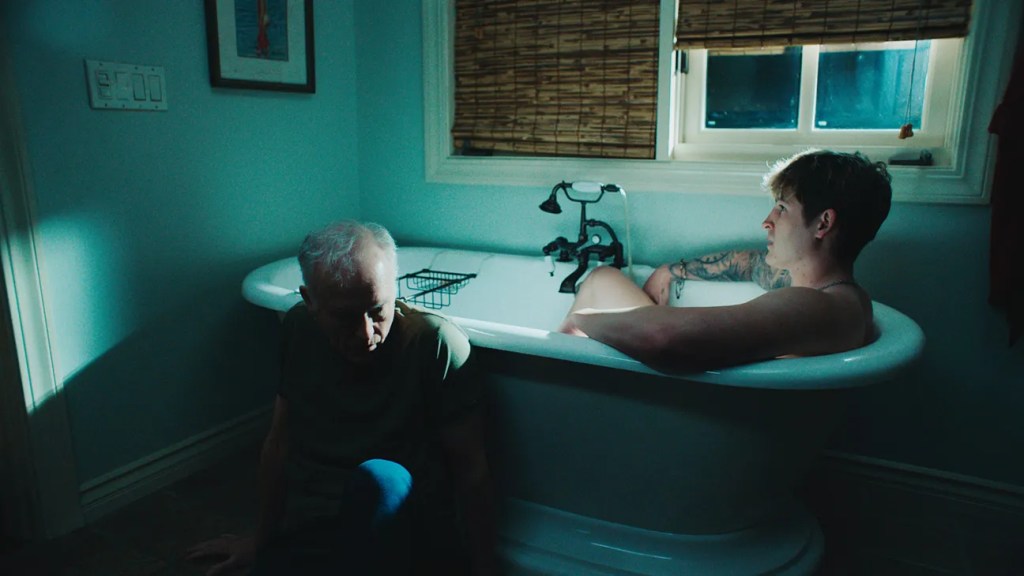
When Blue Film has its good moments, it’s an insightful piece of work. The exploration of dominance and how it often conceals an inner fracture of weakness, or at least perceived weakness, is where Tuttle’s film hits the right marks. At one point, Alex explains he’s meant “to rape these fucking faggots because that‘s what I‘m good at” after telling a story about playing out a rape fantasy during an encounter with a horny couple. Not long after, he tells Hank: “The art of domination is spiritual.” Later when Alex’s sexual psyche is repeatedly broken down, his fragility is fully revealed. He lays bare a genuine desire to lose himself in emotional detachment through hard domination. He’s running from something, partly from himself, too. Blue Film‘s exploration of sexuality and perversion nearly becomes great. If it were simply a character study of Alex, it’d be an intriguing film. When Blue Film deals with Hank, who’s really the majority of its focus, the milk of human kindness curdles.
“I‘ve always known it was wrong“
There’s no real evidence in Blue Film to suggest Hank has actually changed, or that he’s making a true, genuine attempt at changing in spite of him claiming he feels guilt and that he goes to church a lot. He admits to Alex that he actually didn’t let his former prey go many years prior at school like he originally claims, rather the boy escaped his paedophilic clutches. He fondly talks of liking Alex’s legs in gym shorts when Alex was a child, longing to see him in the hallway between periods. He refuses to stop performing oral sex on Alex later after Alex becomes uncomfortable. Their initially consensual sex act turns into something aggressive and violent. Not only is Hank a paedophile, he’s a would-be rapist. Prior to this, Hank required Alex to do creepy role play to turn back the hands of time and get him aroused. Hank shaves Alex’s body; without words, Hank communicates a need for Alex to look like a child physically. Once they’re ready to get intimate, Hank tells him: “It might help me if you‘re a little uncomfortable.” Hank leads the encounter with disgusting role play theatrics: “Have you ever seen another boy‘s penis before?” and “Now you can‘t tell anybody I did this because we could both get in a lot of trouble.” While Hank insists he’ll likely never have sex again after his night with Alex, and desperately tries to convince Alex (along with the audience) that he works hard not to act on paedophilic urges, he leans into his sexual attraction to children while roleplaying with Alex; the urges are ingrained in his psyche and body. The cherry on top of Hank’s rotten sundae is when he tells Alex about pederasty in Ancient Rome, wishing he lived back then when he’d be “celebrated” rather than shunned and ostracised. Worst of all, Hank tries to give context to his own paedophilia by explaining he was sexually abused by his grandfather, also named Hank. He explains that his mother once told him they allowed Grandpa Hank private, sexual access to Hank Jr. because it was better than all three siblings being molested: “We gave him you because it was better than all three of you.” He further excuses his own mother’s horrific behaviour by saying that despite being a bad person, “she didn‘t know to be better.” At every turn, Hank tries to excuse his behaviour rather than fully take ownership of it. While statistically many abusers have been abused themselves, the statistics overall show that most people who were abused do not go on to commit abuse against others; the two statistics are not equal. Even if the statistics read differently, it doesn’t excuse hurt people hurting other people. Blue Film does somewhat address this, though. Alex eventually reveals to Hank that he was never actually molested as he claimed earlier, and that he only said that because he felt a need to explain his own perversity somehow, albeit Alex’s perversity is neither harmful nor exploitative given it’s both legal and consensual, whereas Hank’s perversity is illegal and non-consensual.

Although Blue Film does seem to work, ever so lightly, at not entirely pushing its audience into empathising with a paedophile, it simply doesn’t work hard enough. Something about Tuttle’s own perspective of the film feels misguided, too. Tuttle has said that as an adolescent he once wanted a teacher to want him, which is a normal part of many confused teen hormone fantasies, yet it’s a far cry from being the adult lusting after a child, and it doesn’t warrant empathy for a paedophile. I write this as someone who’s been on the side of the abused. It’s easy to say we should empathise with everyone no matter what they’ve done if you’ve never been seriously harmed, at any age. At the same time, Blue Film nearly gets to a place where it’s challenging the right things, such as ideas about how different people understand sex and their own sexuality. I’m certainly not foolish enough to say that it’s a ‘dangerous’ film in any way, though I do think it verges on being irresponsible. Nevertheless, Tuttle’s made an undeniably transgressive film. At best, it’s a flawed drama ruminating on guilt and sexuality. Att worst, it’s a gross exercise in empathising with monsters. Maybe I’m wrong and Tuttle’s not trying to get us to entirely empathise with Hank, or maybe he’s actually saying that despite Hank’s perceived guilt and supposed attempts at change, Hank remains a monster. Sadly, from where I’m sitting, it doesn’t feel that way.

