
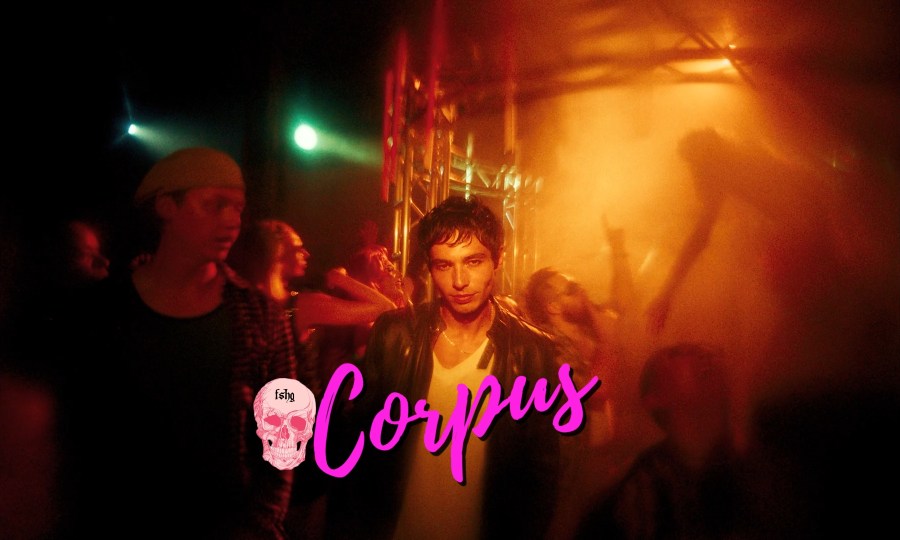
Corpus (2026)
Directed by Corrin Evans
Screenplay by Evans & Lily Cowles
Starring Jeff Wahlberg, Brodie Townsend, Michael Vlamis, Lily Cowles, Nuha Jes Izman, & Ching Valdes-Aran.
Horror
★★★★1/2 (out of ★★★★★)
Corrin Evans’s Corpus had its world premiere at Fantasia 2026, the story of Sayo (Jeff Wahlberg) and Vince (Brodie Townsend), two young men at different points of their artistic careers who also have an on-again, off-again relationship. One night Vince unexpectedly turns up again to party with Sayo and their friend Ross (Michael Vlamis). He invites them to a big house in upstate New York where a trio of women—Cata (Ching Valdes-Aran), Billie (co-writer Lily Cowles), and Wren (Nuha Jes Izman)—are throwing a party. The men realise immediately they’re the only guests invited, and as the night progresses, Sayo starts to wonder if there may be something more sinister at work around them.
In Corpus, eroticism and terror intertwine while Evans and Cowles tell a story that deals with desire, bodies, fame, and more. The film is deeply Gothic, from its big, increasingly spooky house to the looming history in the plot’s background to the eventual madness that unfolds. Corpus can be read as being about several themes. The most fascinating of those involves the objectification of bodies and the potential horrors objectifying people can bring to life. Evans’s concentration on sensual moments throughout the film sit in such wonderfully stark contrast with the darker, more disturbing moments, as she leads us through a gothic exploration of what it can mean to truly feel disembodied, especially when you’re always in front of a lens.
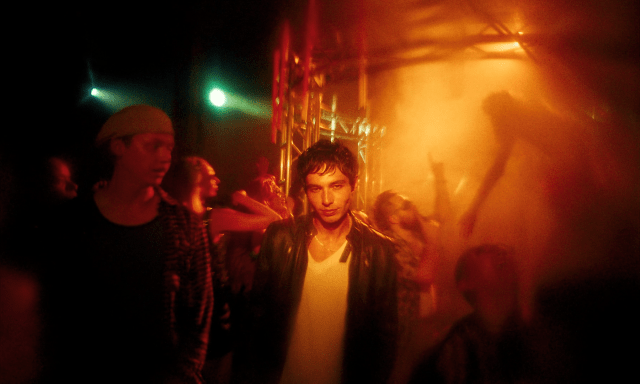
The word ‘corpus’ means ‘body’ in Latin, so it’s a fitting title for Evans’s film because the story, in a couple different ways, revolves around bodies. In a certain sense, Vince, like any Hollywood star, must feel disembodied because the image of his body has become, in a cinematic sense, public property. Stars are not just photographed in studios and on sets, they’re snapped by paparazzi and frenzied fans in the streets, at restaurants, even at home. Vince clearly struggles with what people demand of him now that he’s begun to taste fame. Early on, Vince tells Sayo: “Everyone‘s a poser except you.” He has a desire to be around people who aren’t with him solely to glom onto his new stardom. The cruel irony is that, eventually, he winds up in the clutches of people who see him as nothing more than an object, a vessel through which to channel themselves. In the end, Vince can’t escape the desire of others for him/his body, and winds up more disembodied than he could ever imagine possible.
Art, history, and the otherworldly hover all around Corpus, all pointing towards the film’s themes. John the Baptist is referenced several times since the party the three men go to happens on Saint John’s Eve. This feels like a straight up religious connection, but Saint John’s Eve is also known as Witches’ Night; the famous Voodoo practitioner Marie Laveau used to hold ceremonies commemorating it. You can dig even deeper here with connections to Salome, who demanded John the Baptist’s head, and witches; however, it seems Saint John is revered by Cata, Billie, and Wren due to the fact Saint John’s Eve is about birth rather than death. Corpus reaches into ancient history when Cata shows Vince an astrolabe, an ancient astronomical instrument. She calls it a “star holder” and says it dates back to the late 13th century. Art is a general piece of Corpus, but specific pieces of art make an appearance, and for good reason. In the mansion where Cata hosts the party, we see a copy of Agnus Dei (1635-40) by Francisco de Zurbarán, a famous painting of a lamb with its limbs tied. This connects back to John the Baptist: de Zurbarán’s painting alludes to John 1:29, in which John the Baptist describes Jesus as “The Lamb of God who takes away the sin of the World.” Here we can also consider the concept of the sacrificial lamb; a metaphor that takes unsettling shape later in Corpus. I can’t confirm it, but another painting seen in the upstate New York mansion appears to potentially be an artistic depiction of Narcissus looking at himself in the reflection of a pond. If so, the painting is an intriguing inclusion when considering the, let’s say, physicality of what’s happening in Corpus and the motivations behind it.
Corrin Evans hits the sweet spot in Corpus, tiptoeing a line between eroticism and horror before pulling the rug out from under the viewer and flinging us into full-on terror. At the heart of this sensual gothic horror is the relationship between Sayo and Vince, particularly the conflict that exists in the space between where they each find themselves in their artistic careers. Evans’s film, among other things, addresses how sometimes wanting someone can transform into wanting to be them. Above all, Corpus can be read as a tale of objectification and how much damage objectifying people does to the body and the psyche. While the film ends following a series of horrifying events, it does close on what could be considered a moment of liberation and power, though the bodily traumas that precede it are more than enough to leave you haunted.

