
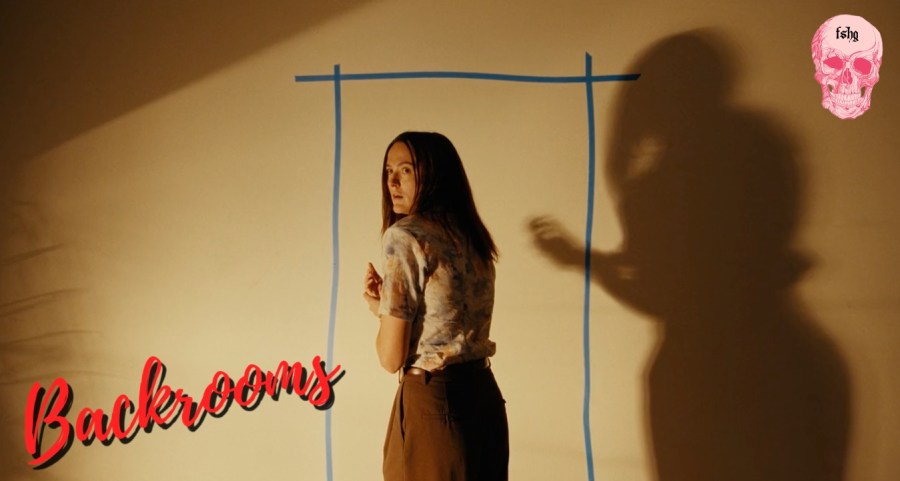
Backrooms (2026)
Directed by Kane Parsons
Screenplay by Will Soodik
Starring Chiwetel Ejiofor, Renate Reinsve, Mark Duplass, Finn Bennett, & Lukita Maxwell.
Horror
★★★★1/2 (out of ★★★★★)
DISCLAIMER:
The following essay contains SIGNIFICANT SPOILERS!
Turn back lest ye be spoilt.
In Kane Parsons’s Backrooms, Clark (Chiwetel Ejiofor) is an architect-turned-salesman who owns a furniture store called Cap’n Clark’s Ottoman Empire, and his life has been a bit rough lately. His wife left him and kicked him out of the house. He’s in therapy with Mary (Renate Reinsve), who tries her best to get him to own up to his mistakes and move forward with his life. One day when the power goes a little haywire at the store, Clark stumbles onto a door that shouldn’t exist and tumbles into a space behind the walls that doesn’t seem to end. He ventures further into the space to find there are not only empty rooms, chairs, and piles of clothes, but someone or something else is in there with him. Eventually Clark disappears entirely, so Mary’s forced to go into the same space to search for him.
Backrooms is a haunting, psychosocial horror film that uses Gothic elements such as the Uncanny to explore how people can lose themselves in a world of broken memories/dreams and the daily, mind-numbing grind of capitalism. Clark’s odyssey into the film’s eponymous space is a figurative trip into his mind, as he grapples with the ruin of his marriage and what he views as a failure to live up to earlier career aspirations, all manifesting in a surreal waking nightmare from which he and others might never escape.
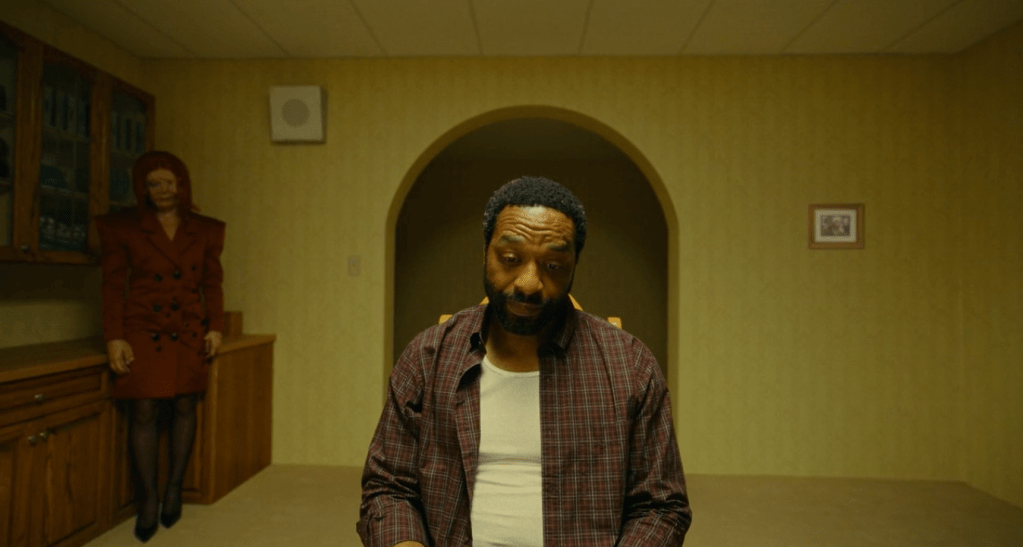
The backrooms are a psychosocial labyrinth in which people become trapped, and for Clark, they reflect his deepest fears and anxieties. Clark is an architect but not working as one, and the ever-shifting, ever-multiplying, ever-scattered world of the backrooms can be read as commentary on his scattered psyche while worries about his architectural career, and his current place in the capitalist hierarchy as a furniture store owner, loom in the background. Early in the film, Clark doodles on a piece of paper, the kind of unconscious doodling many of us used to do while on a landline phone. Later he’s creating more elaborate mapping after entering the backrooms. Clark’s architectural education is always present, but because of his marriage and his failed ambitions, his architectural career is now nothing other than doodles and dreams. There’s also the fact that Clark isolates himself, believing he only hurts people constantly, so the backrooms become a space in which Clark can stay at arm’s length from reality. On a tape of Mary’s book, she says: “Your consciousness is a room full of memories that is constantly evolving. But as you walk through life, the untrained mind can start to build walls, put up barriers, to protect itself from the outside world . . . You can become convinced that the world outside is better off without you.” For Clark, the backrooms are a place of unexplored possibilities because his life’s possibilities, in his mind, have reduced to very little. Unfortunately, he loses himself within those unexplored possibilities, and even draws Mary into them, nearly at the cost of her life. In the end, Clark’s monstrous self—a haunting vision of what capitalism has rendered him, a gigantic mascot for Cap’n Clark’s Ottoman Empire—tears him apart, and almost does the same to Mary.
Perhaps the most glaring commentary on display throughout Backrooms is one that reaches into the world of sociologist/philosopher Jean Baudrillard’s theory regarding simulacra. Backrooms confronts a world of decaying simulacra in which reality itself loses form the more it’s copied and reproduced. When Clark first discovers the backrooms, he tells Mary it’s as if the store just continues behind its walls “like a copy of itself.” Even Cap’n Clark’s Ottoman Empire as the store name is symbolic of the issue with simulacra, in that original meanings become lost with each copy of a copy. The store’s name mixes its own allusions, combining pirates with the Ottoman Empire. Bobby (Finn Bennett), who helps Clark film commercials and eventually goes exploring the backrooms with him, questions whether Clark’s commercial character is a pirate or a sultan so that it comes across clearly on a marketing level. Clark hits the nail directly on the head when he explains the various copies of people and things within the space, telling Mary that “the more times it remembers something, the less it does.” The ‘people’ in the backrooms also “simply exist, like furniture . . . no thoughts, no pain, no ego, no fear.” Essentially, peoples’ souls and the essence of objects are removed the more they’re duplicated within the backrooms. Many people have already read Backrooms as a metaphor about generative AI, and in the people in the backrooms, as well as the space itself, we see how each recycling of their essence dilutes it, exactly how AI dilutes art. The imagery in Backrooms is actually reminiscent of early generative AI images which felt, as Clark puts it, like “describing a dog to someone who’s never seen a dog and asking them to draw it.” What’s maybe most unsettling in the film is that even Clark’s life is more like a copy of a real life than an actual life since he sleeps in his store on display furniture with a photo of him and his wife on the bedside table. Outside of the backrooms themselves, Clark’s already living in his own little simulacrum in his makeshift bedroom. And just as the people/spaces seem to decay or come undone in the backrooms, so has Clark’s life decayed in his simulacrum: he once lived in a house with his wife, now lives on display in a store with temporary, soon-to-be-sold furniture and only a photo of his wife.

Along with Clark’s feelings of failure due to not currently working in architecture, Backrooms deals with the psychological horror of capitalism through Mary and the cement handprint she holds onto from her youth. The handprint is Mary’s desperate attempt to hang onto something concrete and familiar in a fleeting, transforming world built on capitalism’s ‘progress for the sake of progress’ ideology. Her old childhood home was knocked down to make way for apartment buildings. Any memories she had there whether good or bad were, in a sense, destroyed with the house itself, so the only place her childhood home exists is in her mind. We get glimpses of a troubled childhood with a mentally ill mother, but, as memory isn’t always trustworthy, maybe she doesn’t remember everything exactly as it was once. This is why Mary holds onto the cement handprint: it’s a souvenir of the physical place where she lived, perhaps the only thing she can guarantee is real. Perfectly, Mary later uses the piece of cement with the handprint of her younger self in it to bludgeon the gigantic, monstrous Cap’n Clark; a piece of the literal concrete world beyond the backrooms actually helps Mary escape.
Unfortunately, on some level, many of us are currently stuck in the backrooms of contemporary life, though a lot of us won’t be torn to bits and swallowed by a monstrous version of ourselves—at least not literally, anyway. As Backrooms illustrates, part of getting lost in those existential corridors is allowing ourselves to be hypnotised and lured into such a space. At the first sight of danger, Clark should’ve made another choice instead of walking down yet another dark hallway. Clark’s damaged emotional state and desperation to rise up in the capitalist hierarchy drives him to a place of no return. We can’t let ourselves get lost in our failures and tragedies, nor can we allow ourselves to be chewed up and spit out by capitalism. Backrooms is a disturbing exploration of the terror our minds can create, a figurative tale about how we make the psychological into the literal when we get too lost in the darkness of our thoughts and the expectations of a cold, uncaring capitalist world.

