

Leviticus (2026)
Directed & Written by Adrian Chiarella
Starring Stacy Clausen, Joe Bird, Ewen Leslie, Mia Wasikowska, Jeremy Blewitt, & Davida McKenzie.
Horror
★★★★1/2 (out of ★★★★★)
DISCLAIMER:
The following essay contains SPOILERS!
All hope abandon, ye who enter here.
Adrian Chiarella’s Leviticus tracks the troubled gay relationship between two teen boys in a small Australian town, as Naim (Joe Bird) and Ryan (Stacy Clausen) struggle to be together while their religious families and town push them apart. When Naim witnesses Ryan kissing another local boy called Hunter (Jeremy Blewitt), he angrily outs them to Hunter’s parents. Ryan and Hunter are then forced to undergo a strange form of religious conversion therapy, which is bad enough. What’s worse, Hunter and Ryan each start to be stalked by an invisible presence that wants to hurt them, and even kill them. Eventually Naim is subjected to the same religious madness as Hunter and Ryan, putting him directly in the presence’s destructive path, too.
Leviticus is a Queer Gothic tragedy, equal parts romance and terror. It’s a film about religious hatred of homosexuality and what it does specifically to young people. It deals with the way hatred comes from both external and internal forces, as the small-town religious community attempts to force its young men to expel homosexuality from their identities and those same young men begin to internalise all the hatred they’re forced to endure. Chiarella’s film is a terrifying depiction of queer love under pressure, and though there is a slight glimmer of hope in the end, there still remains a lingering worry about how that pressure could continue to haunt Ryan and Naim—forever and ever, amen.
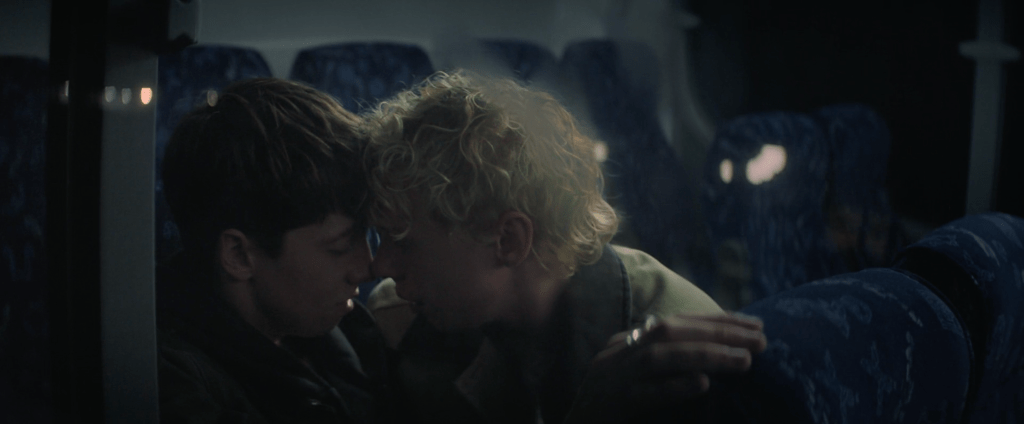
One of the more devastating aspects of Leviticus is its depiction of the way in which queer people, especially young queer people, internalise the homophobia directed at them. The invisible force stalking the teens can be read as internalised homophobia’s constant presence in their lives. Ryan tells Naim early on after the force has begun tormenting them: “We have to stop.” He actively tries to deny, or at least suppress, his own homosexuality. It gets worse, as Ryan later asks Naim: “What if we‘re only making it stronger?” Here, he’s fully internalising homophobia, blaming himself, Naim, and their affection for one another for what’s happening to them. Somewhat related, after Hunter’s death, Naim’s mother Arlene (Mia Wasikowska) says that hate is what killed Hunter, but she then forces her own son to go through the same ‘deliverance healing’ as Ryan and Hunter, rather than focus on the hateful external forces working to repress Naim, Ryan, and Hunter. Later, Naim tells his mother that ever since meeting the healer, he’s “been getting hurt” and she, rather callously, says that she knows but believed it would somehow keep him safe. Arlene tells Naim: “We need fear . . . it‘s how we survive.” Instead of supporting her son she’s more inclined to subject her son to painful religious conversion therapy, driven more by fear of how the community will perceive her and her family instead of being driven by love, which is unfortunately all too common when it comes to religious parents and their lack of acceptance of queerness. As they say, there’s no hate like Christian love.
Obviously the Bible plays a major role in Leviticus, clear enough by the film’s name, but there are a number of references and symbols that appear in Chiarella’s film which deepen its unsettling religious themes. The actual Book of Leviticus comes into play in two different ways. First, Leviticus 18:22 is where the most popularly quoted verse related to homosexuality comes from: “You shall not lie with a male as with a woman; it is an abomination.” Second, and most importantly for the film, Leviticus 20:13 relates to capital punishment prescribed for men who engage in same-sex sexual acts: “If a man lies with a male as he lies with a woman, both of them have committed an abomination. They shall surely be put to death. Their blood shall be upon them.” While stoning doesn’t appear here, “Their blood shall be upon them” has historically been interpreted by many scholars as a reference to stoning. What’s so significant in the context of the film is that at a couple points we see Ryan and Hunter throwing a big rock at each other. What’s even more significant is that one of those instances occurs when Hunter’s being attacked by the invisible force, right before being brutalised and eventually killed by it.
A less obvious but no less significant symbol in Leviticus is a brief shot near the start of the film featuring a snake swallowing a frog. Snakes and frogs both appear throughout the Bible in ways that give more context to this image in Leviticus. Most people will recognise that Satan in the form of a serpent appears prominently in the story of Adam and Eve in the Garden of Eden, the snake representing deceit and sin. The frog is even more telling symbolically since, in the Bible, they’re generally symbolic of plagues, uncleanness, and the deceptive nature of demonic forces. Frogs appear in Exodus 8 when God sends a second plague to Egypt. They likewise appear in Revelation 16:13 when three unclean, demonic spirits that look like frogs come out of the mouths of the Dragon, the Beast, and the False Prophet. We can then look at the snake swallowing the frog in Leviticus as an image of Satan—the snake in the Garden of Eden and the Beast in Revelation—who lurks on the periphery of the small town in the film, its presence a kind of marker of apocalypse, at least in terms of how the religious community feels about the homosexuality in their heteronormative midst.
Fire is another major symbol in Leviticus, as the so-called deliverance healer uses fire to “Make new what was defiled” and speaks of “Two fires: one to defile and one to reform.” The first significance of fire in a story about homosexuality is that it relates to the slur faggot. While the f-slur has had other meanings throughout history, it’s also referred to bundles of sticks that were “used in the burning alive of people regarded as heretics.” There’s also another verse in Leviticus, 10:2, which states, like other Bible verses, that fire comes right from God: “So fire came out from the presence of the Lord and consumed them, and they died before the Lord.” The most compelling part about fire in Leviticus is ultimately how Naim is able to turn fire back against the invisible presence the deliverance healer conjured up to torment and potentially kill them. The only way Naim is able to repel the presence is to use fire. Though, unfortunately, it doesn’t quite kill the presence or drive it away entirely.

Leviticus is a deeply painful film to watch if you’re queer or a genuine ally to queer people. For us queers, it’s a reminder of what many of us struggled through as young people, doubly so for those who grew up surrounded by religion. And although religion is not the only source of bigotry that affects queer people, it’s certainly one of the biggest and most enduring sources; even people who aren’t religious still repeat much of the queer hate rhetoric that religion has propagated. Despite how painful Leviticus is, and how tragic much of it feels, it’s also a beautiful example of Queer Gothic. Even if the invisible entity continues to torment Naim and Ryan, they prove just how hard queer people are willing to fight back against the encroaching darkness of bigotry and repression in order to the live the life they deserve to live.

