
Obsession (2026)
Directed & Written by Curry Barker
Starring Michael Johnston, Inde Navarrette, Cooper Tomlinson, & Megan Lawless.
Horror
★★★★★ (out of ★★★★★)
Curry Barker’s Obsession is told from the perspective of Bear (Michael Johnston), a young man infatuated with his friend Nikki (Inde Navarrette). Problem is he can’t bring himself to tell her how he feels. Bear happens upon a shop one night where he discovers a seemingly jokey product called One Wish Willow, promising that a person’s one wish will suddenly come true. He decides to use this to make Nikki love him “more than anyone in the fucking world.” And it works. But right from the start, Bear’s wish doesn’t feel like it’s coming true perfectly, as Nikki’s behaviour wavers between lovesick and completely unhinged. Still, the pair fall in love and become an inseparable couple, which even their friends start to question. As Nikki’s behaviour gets very wild, and at times very creepy, Bear starts to realise his wish was misguided, though he has no way of understanding just how terrifying his wish will wind up becoming in the end.
Obsession is a brilliant horror tale of consent and the difference between romance v. love. Considering the state of both masculinity and media literacy in The Year of Our Lord 2026, many men, incels or not, will likely watch this movie in a far different way than it’s intended to be watched, reading Nikki’s relentlessly scary ‘love’ for Bear as the obsession of a ‘crazy’ woman. In reality, Obsession is about how male obsession with finding a woman to adore and worship them often winds up being expressed through dangerous, toxic behaviour that degrades and destroys women.
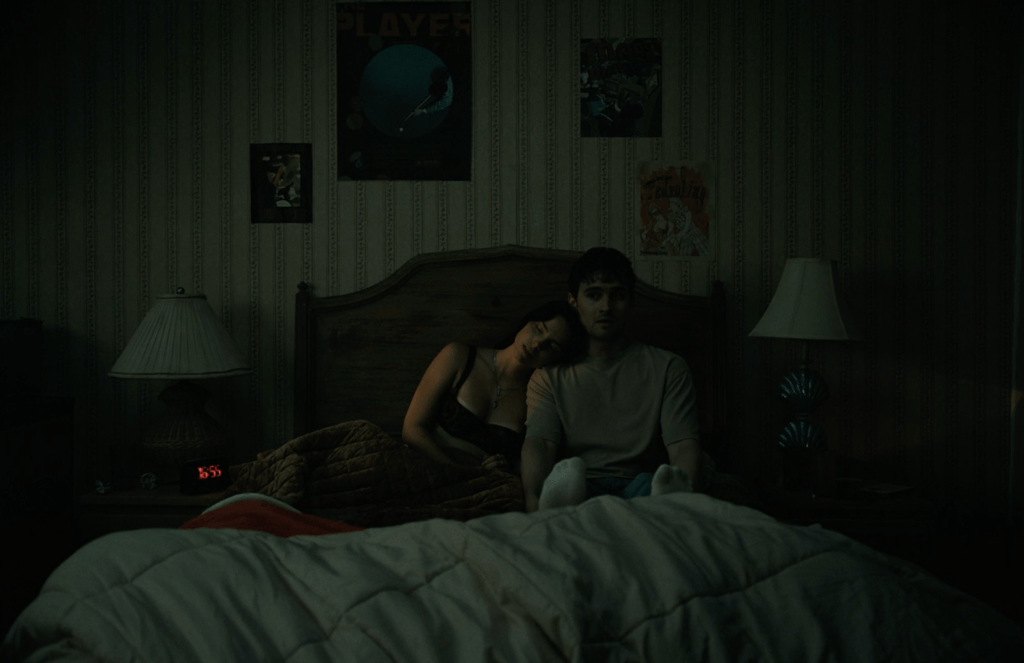
Obsession is a disturbing horror-film perspective on consent, and as others have already written it comes across as what might be termed ‘incel horror’ because the premise is that Bear’s too cowardly to work for Nikki’s love by being honest with her and instead resorts, at least inadvertently at first, to a supernatural fix to gain her love and unconditional affection. In one early scene, Bear has the chance to tell Nikki directly how he feels but chooses not to out of cowardice—a recurring theme in Bear’s life—and if he’d only confessed his feelings, Nikki might’ve actually wanted to be with him for real. Instead, Bear effectively removes consent from the entire situation via the One Wish Willow. After the wish, Nikki acts strangely, at one moment seeming into Bear and in the next moment freaked out by their kissing. When she recoils from him, Bear, without any shred of self-awareness tells her: “You made me feel like I did something you didn‘t like.” At this point he’s oblivious to how he’s already forcibly removed Nikki’s ability to consent. The most disturbing moment where consent, or a lack of, rears its head is when we see Bear on top of Nikki in bed fucking her and it’s as if she’s a ragdoll, her eyes all but blank, her mind elsewhere, as if she’s not even present; the face of a rape victim. In a film with a number of horrifying images, this moment is perhaps the most horrific because not only has Bear used supernatural power to make Nikki love him, he’s used that power in order to basically force Nikki to have sex with him. Later, issues of consent become more apparent and unsettling. One scene features Nikki talking in her sleep and it’s quickly obvious that the real Nikki is trapped within, able to understand what’s happening to her yet incapable of breaking through the ‘love’ spell cast upon her. The real Nikki, slipping out while the fake Nikki sleeps, pleads with Bear: “Kill me, please.” What’s more troubling is that Bear takes this as a reflection on himself, wondering what’s so bad about being in love with him, rather than recognising the wreckage of his cruel desire.
Obsession contains a number of allusions to other media and literature, some more thematically significant than others. The initial most obvious allusion is to the short story “The Monkey’s Paw” by W. W. Jacobs; Barker credits rewatching The Simpsons’ “Treehouse of Horror II” with the inspiration rather than Jacobs specifically. There’s also a great somewhat background moment when the quizmaster at trivia night asks a question about Disney’s Aladdin. One of the things the Genie warns Aladdin is that you can’t wish to make someone love you. The One Wish Willow itself is an update of the Monkey’s Paw, but also of love potions which have appeared throughout literature for thousands of years. In Gothic and Dark Romantic literature, love potions are typically a thematic exploration of obsession, perfectly fitting the title of Barker’s film. A particularly tragic instance of the love potion is in the medieval legend of Tristan and Isolde, as the accidental ingestion of said potion—in different versions, it goes from accidental to purposeful—eventually leads to both of their sorrowful deaths. Even in Shakespeare’s A Midsummer Night’s Dream, Puck’s use of an enchantment to put Titania under a love spell doesn’t result in a sweet sense of love, rather it’s played for comedy and humiliation, resulting in a previously powerful woman becoming like a fawning schoolgirl. Ultimately, the love potion sits in dark parallel with contemporary date-rape drugs, and this is exactly how Bear uses it, even if he can’t admit it. He uses the One Wish Willow not believing it’ll really work but also not considering that maybe Nikki just doesn’t want to be any more than a friend to him. It’s only later in the film when Bear considers the consequences of what he’s done to Nikki, yet, in the end, he chooses cowardice once again by leaving Nikki, for all intents and purposes a survivor of sexual abuse at his hands, the only one left alive to face the consequences of his actions while he dies on the floor foaming at the mouth like his poor cat Sandy.
Early in the film, Bear says that Nikki’s writing a romance novel, but she almost angrily rebukes this, saying that the novel she’s writing “is a love story, not a romance” because there’s a difference between romance and love. Romance is generally considered something that can happen at any moment with a quick glance across a crowded room or a sudden meeting on the street when you bump into someone cute, and it’s rarely that in reality. Love requires time, investment, hard work, and, quite often, sacrifice. Robert Johnson writes in We: Understanding the Psychology of Romantic Love: “The fact that we say ‘romance‘ when we mean ‘love‘ shows us that underneath our language there is a psychological muddle. We are confusing two great psychological systems within us, and this has a devastating effect on our lives and our relationships.” The confusion of romance v. love is exactly why Bear sees nothing initially wrong with his One Willow Wish or the results. Bear wants love without the work. He’s not even willing to just admit his feelings to Nikki and see where things go from there. He wants instant gratification, he wants romance, not love and all it entails. The One Wish Willow actually turns love into something that can be commodified, traded, or stolen, rather than a beautiful, tender human emotion given willingly to another.
Barker’s film is simultaneously timeless and also a thoroughly 2026 horror story. Boys and young men are, more than ever, being bombarded with misogynistic propaganda every single day online teaching them that women should be subservient to them, should worship them, should obey them, and that they shouldn’t have to do anything for women to receive their affection. Obsession is a terrifying parable about the pitiful and dangerous state of masculinity in the 21st century, using a vicious metaphor to cut straight to the bone. For the media-literate young or grown men who see Obsession, it should force us to contemplate the real-life horror film in which girls and women are forced to live due to toxic masculine ideology.


I was sitting next to someone that was thinking of Nikki as a “crazy woman” and laughing at all these horrifying (to me) moments in the film. It was a really unsettling experience! I couldn’t help but wonder if Barker’s YouTube comedy roots brought in a wide variety of viewers to Obsession. Thank you for the great post!
LikeLiked by 1 person