
Upiro (2026)
Directed by Óscar Martín
Screenplay by Elena Muñoz
Starring Pauline Brisy, Diego Anido, & Victoria Cerrada.
Horror
★★★★1/2 (out of ★★★★★)
Óscar Martín’s Upiro takes place in 1755 Spain within a little convent where Ana (Pauline Brisy) is sent by her aristocrat father to atone for her sins. When she arrives she’s greeted by an isolated world over which the Mother Superior and a priest rule. She soon meets Sister Remedios (Victoria Cerrada) and the rest of the hopeful nuns. Yet there’s something strange going on. Some sisters are waking up with odd bites on their feet and feeling strange. Then, worse things occur. Ana wonders whether a supernatural entity is lurking in the convent, or if there’s a much more human threat amongst the pious sisters’ repressed world.
Upiro uses the figure of the vampire in a unique way to comment not only on patriarchal ideology but also on how nuns in the Catholic Church help uphold such an ideology. Inspired by the first case of vampirism in Spain documented by the Catholic Church, Martín’s film utilises Gothic horror to explore how Catholicism has more in common with BDSM and vampirism than Christ and his earliest followers surely intended.
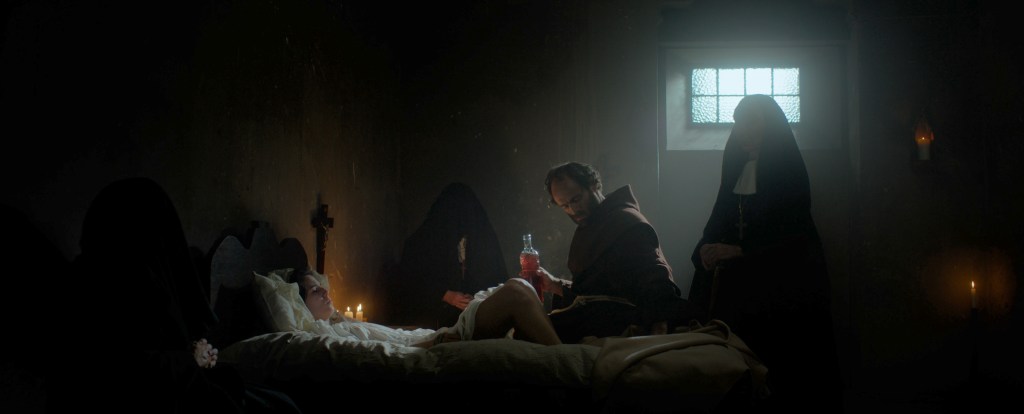
Upiro confronts repression in the Catholic Church via an unhealthy, and counterintuitive, denial of earthly pleasures. The sisters don’t even bathe naked, as if denying their own physical form’s nakedness will somehow make it easier to deny their temptations. The sisters are so far removed from natural life that they see nothing beyond the scope of Christianity and, more specifically, their role as women under the Church. At one point Ana asks another sister if she’s ever had a boyfriend to which the sister responds: “Of course. Our Lord.” They see themselves as brides of Christ. Worst of all, the priest who eventually moves into the convent blurs the lines between medicine and sexuality. At one point a sister is inflicted with supposed stigmata, after which the priest, for lack of a better word, masturbates her as a form of therapy: “Warmth and friction will relieve you.” No sex allowed, except when the creepy priest needs to finger you to relieve the spiritual tension. The priest, and even Mother Superior, crosses lines from religion into BDSM that become deeply uncomfortable, even if there’s no actual straying from legit Catholic beliefs.
Upiro gets at how a strange dichotomy of the body exists in Catholicism (and other religions) that essentially insists you can’t enjoy the flesh, but you can inflict pain upon it. Catholic practices bleed into bondage across many scenes in the film. When Ana is punished, she’s fitted with a “scold’s bridle” before she’s bent over and spanked with a cat o’ nine tails made of rope. The overall atmosphere of Catholic BDSM has fully infected the sisters, just as the priest worries about the vampire’s infection doing the same. One sister explains to Ana: “Pain is good . . . Martyrs are tortured to ecstasy. And that is the greatest pleasure that can exist.” There are already threads connecting certain religious practices, such as self-flagellation, to BDSM, but Upiro draws those threads together in a skin-crawling way.
Without spoilers, Upiro addresses how it’s not only men who uphold the patriarchal ideology at the heart of Catholicism, women of the church likewise help prop it up. The young sisters hoping they’ll be married off to Jesus soon are led to believe that ‘part of their nature’ is to give their bodies over to patriarchal forces and offer themselves as sacrifices at the altar of religion and tradition. Upiro is a Gothic film about two types of infections: vampirism and unchallenged belief. Some of the young sisters end up being sacrifices while another sister is pulled into an endless cycle of helping Catholicism maintain its patriarchal hold on men and women alike.

