
Appofeniacs (2026)
Directed & Written by Chris Marrs Piliero
Starring Aaron Holliday, Jermaine Fowler, Sean Gunn, Michael Abbott Jr., Will Brandt, Paige Searcy, Simran Jehani, & Harley Bronwyn.
Horror / Thriller
★★★1/2 (out of ★★★★★)
Chris Marrs Piliero’s Appofeniacs contains multiple plots in a single story all pulled together by the petty Duke (Aaron Holliday), a man who uses deepfake AI technology to lash out at anybody around him whom he perceives is slighting him. Each time Duke uses this tech, the bloodier things get, though he doesn’t even pay attention to what results from his digital lies. The blood gets out of control as the widening circle of Duke’s collateral damage gets worse and winds up blowing back directly on him.
The entirety of Appofeniacs is a metaphor for the destructive progress of generative AI technologies. Duke spends nearly all of his time in the film oblivious to the actual damage he’s caused by creating deepfakes of other people. His deepfakes create real-life consequences that reverberate through the lives of others. Just like generative AI being used obliviously by those who don’t or won’t consider the actual consequences of such a tech. Appofeniacs is a dark satire of technology’s current state, and a prophetic horror about the terrifying techno-social world in which we now exist.
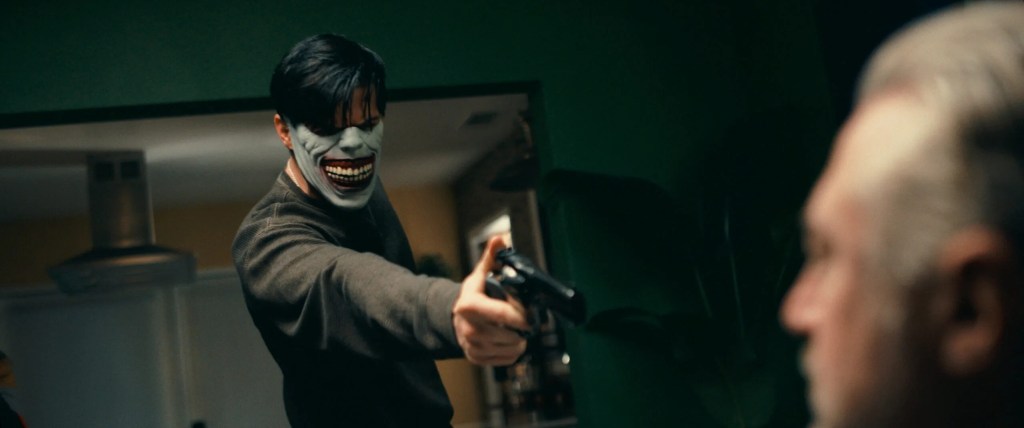
The problem in Appofeniacs, as it is in real life, is that turning fantasy into reality isn’t just a utopic kind of idea, there are also all the fantasies people have that are horrific. Duke is a conduit, representing all the worst instincts of the worst people who’ll use generative AI technologies on a whim to do awful things to those they hate. His AI deepfakes have brutal repercussions in the lives of others, yet he treats it as a big game. He laughs and says that reality is “about to get real confusing.” Duke is every lame dude who doesn’t see the consequences of a technology like AI, believing that if there are any consequences they won’t affect him—at least until the consequences inevitably make it back to his doorstep, but, as it will be in the real world, it’s too damn late.
There are two great counterpoints to Duke. First is Clinto Binto (Sean Gunn), a serious cosplay costume and accessory creator who goes above and beyond to make cosplayers look unique. His craft goes against generative AI’s premise. His creations aren’t mere cosplay, they’re true-to-life recreations of fictional costumes and weaponry. His art reaffirms the physical world and the importance of real art created by real people. Second is Lazzy (Paige Searcy), a target of Duke’s AI wrath, because she understands that the physical world, and real art like Clinto’s cosplay creations, will always beat AI’s smoke and mirrors. She explains to a friend, referring to the streaming v. physical media debate, that “when you’ve got the physical thing, they can’t fuck with it.”
Appofeniacs is definitely a satirical film and it’s at times very funny. Beyond its satire is a grim, unnerving truth about the way people are already engaging with AI without any concern for what it will do, whether on an individual level, such as ChatGPT talking vulnerable people into suicide—which has already happened—or on a wider scale, such as the environmental impact generative AI’s already had and continues to have at an increasing rate. Appofeniacs is a great metaphor about all the unintended consequences generative AI has begun to have ever since the world’s technovillains unleashed it into the wild and into the digital hands of an unprepared, ignorant public. Piliero’s film is a wild horror-thriller that pushes back against blind acceptance of AI. In its final act, Appofeniacs makes clear that the best thing we can do is continue looking to the hope within real, tangible, physical art as an antidote to AI’s lazy, dangerous terrors.


Pingback: This Week at the Movies (Oct. 9, 2026) – Online Film Critics Society