
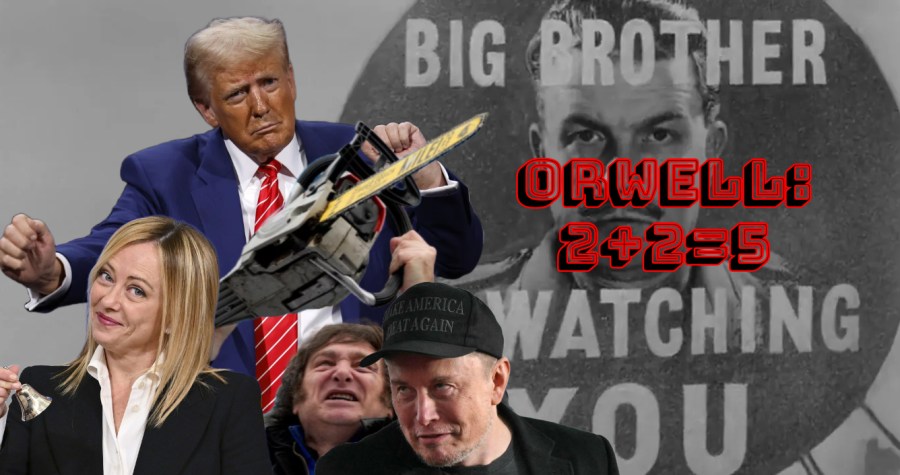
Orwell: 2+2=5
Directed & Written by Raoul Peck
Starring Damian Lewis (as the voice of George Orwell)
Documentary
★★★★★ (out of ★★★★★)
Similar to Adam Curtis, Raoul Peck’s fascinating, sprawling documentaries feel inspired by John Dos Passos, specifically the U.S.A. trilogy, in how they draw together so much material over such a long span of history. Orwell: 2+2=5 does this especially well considering the vast amount of material from a number of countries and cultures Peck gathers together. Peck uses George Orwell’s 1984, including Damian Lewis as the voice of Orwell, as a premise for grappling with the increasing rise of fascism, autocracy, and oligarchy across the globe, touching on the rhetoric as well as the political views and/or policies of Donald Trump, Elon Musk, Narendra Modi, Giorgia Meloni, Vladimir Putin, Mark Zuckerberg, Lin Junyue, and more.
Peck has an uncanny ability to bring together so many threads at once while never losing his audience. In Orwell: 2+2=5, Peck diagnoses the symptoms of a sick world diseased with the sickly rot of dangerous fabricated narratives, unregulated artificial intelligence, widespread surveillance, and staggering wealth inequality; the only cure is a cocktail of awareness and education, like this documentary.

Orwell haunts our current culture, whether it’s references to 1984 in the zeitgeist or just how Orwell was himself dealing with things that, at this point for us, have become old hat. He wrote that the “opinion that art should have nothing to do with politics is itself a political attitude.” This quote is right at home in 2026, as right-wingers complain about everything in media being too injected with politics; that is, until something like the latest Uwe Boll film comes along to directly appeal to their worst sociopolitical impulses, then politics are quite welcome apparently. Orwell also haunts us every single day as the language of politics works overtime to make “lies sound truthful,” from the use of the word ‘illegals’ to refer to immigrants and refugees, to today seeing antisemitism cruelly weaponised to silence critics of Israeli genocide.
Peck expertly shows how Orwell’s ghost lingers across media as he plays clips of George W. Bush, Vladimir Putin, Donald Trump, and others telling tall tales about various wars and events. Most haunting is seeing history repeat itself and the truth being manipulated, across so many cultures and countries, in order to justify the same kinds of abject human cruelty over and over and over again. Peck juxtaposes Nazi book burnings with similar burnings in Chile 1973, Mali 2013, and Gaza 2024, as well as brutal military operations in Spain 1937, Iraq 2003, Yemen 2015, Palestine 2023, and Lebanon 2024, then the dehumanisation of hostages/prisoners in Lviv 1941, Afghanistan 2010, Honduras 2023, El Salvador 2023, West Bank Palestine 2024. He connects a horrifying roulette of misery through Orwell’s observations about how a belief in atrocities has gradually twisted into a matter of political affiliation; once again, truth has detached from reality and re-attached itself to political convenience, as usual coming at the cost of human life/quality of life.
Orwell’s concern with the manipulation of truth and the weaponisation of narrative is increased tenfold by Peck looking at the rise of social media and AI. As Maria Ressa puts it, social media spreads lies “faster than facts while amplifying fear and anger.” Not only that but tech CEOs have turned a blind eye to child exploitation, fact checking, and the growth of white supremacy under their pathetically relaxed boundaries. Peck includes one shot of Trump in an AI image featuring The Donald being friendly with Black people, as well as a clip of Trump claiming “the Blacks” love him. AI is the zenith of truth manipulation, and it’s so dangerous because it’s visual. It’s one thing to speak lies, it’s another thing to visualise them and, effectively, bring them to life. This creates the potential, and likelihood, of horrors far beyond even what Orwell could have imagined.
In a semi-exasperated tone, Orwell wrote: “Oh, what a piece of work is the pursuit of truth.” The truth isn’t necessarily easy; it’s often difficult, messy, and even terrifying. Orwell knew that, as he was a product of imperialism in certain ways and worked towards dismantling the myths that came along with the “monstrous intrusion of imperialism.” The most important part in the quest for the truth is to maintain your own morality. Orwell wrote: “My chief hope for the future is that the common people have never parted company with their moral code.” Sometimes when confronted with systemic monstrosity, it becomes easier to let our moral code shift. Orwell: 2 + 2 = 5 looks at the slippery slope of mishandling the truth and making truth an element of politics rather than treating the truth as an objective reality. Sometimes we do have to fight back, even violently, against monstrous institutions and the people that uphold them. But when the truth is at stake, we can’t fight those who intend to warp it by warping it ourselves. Peck’s documentary urges that people and communities must remain steadfast in remembering their morality and their united power, as well as that the truth isn’t a political slogan or propaganda, it’s simply the truth, warts and all.

