
Posthumous (2026)
Directed by Josh Tanner
Screenplay by Tanner & Jade va der Lei
Starring Sophie Lowe, David Roberts, Doris Younane, Remy Hii, Christopher James Baker, & Kira-Che Heelan.
Horror
★★★★ (out of ★★★★★)
Josh Tanner’s Posthumous, recently screened at Brooklyn Horror Film Festival, follows Zoe (Sophie Lowe) as she stays with her father while they still grieve her dead mother despite quite some time passing. Zoe goes through a bunch of old VHS tapes featuring her mother wishing her a happy birthday across the years. She comes upon some tapes she never knew about that start to paint a different picture of her parents, as well as the very night she was born. Against her father’s wishes, Zoe keeps on probing the past, and sooner than later, darkness comes rushing into the present.
Posthumous joins other recent horror films that use VHS tapes and the VCR as a vehicle into memory and the repressed past, such as the recent Death of a Yellow Bird; we might call it Tech Gothic. Tanner does a great job relying on the emotional as much as the supernatural to create anxiety and horror. Posthumous’s most important element is how its story addresses the Gothic void left in us when our own origins are lost to us, turning our world into a world of ghosts that will only ever keep on haunting rather than healing.
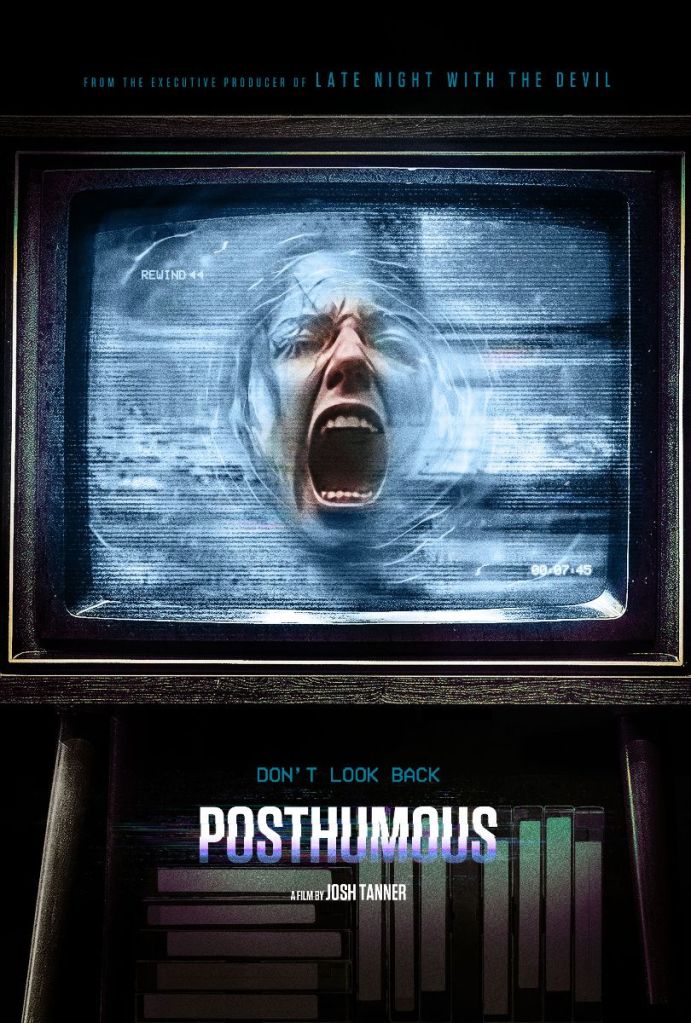
Posthumous is Tech Gothic because it deals with how we can be haunted by someone’s loss and then connect with their spirit through technology, as portrayed in Zoe’s connection with her mother beyond the grave using the VHS tapes. Loss is a physical thing, which Zoe expresses to her father about the depths of feeling the loss of her mother: “I can feel the void that she left.” Zoe fills that void via tech and also discovers the hidden, repressed past, too. VHS gives Zoe access to a past she would’ve otherwise only ever known had her father spoken about it to her, and that almost certainly never would’ve happened. Technology rarely forgets like humans, and unless humans manipulate it, it simply bears witness to the truth presented to its lens. Through the tapes, Zoe gets nothing but the naked, ugly truth about what happened the night she was born and what’s happening to her now.
It’s the festering past that comes back to haunt Zoe and her father in Posthumous, a common Gothic theme. Zoe’s been figuratively left in the dark about her past all her life, and when a terrible entity from the past comes looking for her she’s told it preys on “the darkness within.” The entity essentially becomes part of Zoe, a symbolic rot comprised of what was hidden from her. Posthumous may be Tech Gothic, but it’s also classically Gothic in that it deals with the horrible powers of the repressed past and how they can wreak havoc on the present. Even the VCR becomes like a monster, biting Zoe’s finger, and, during a dream she has later, something inside it seems to try crawling out at her.
It may be the elder millennial in me but VHS strikes a nostalgic chord whenever it makes an appearance in contemporary media, yet Posthumous doesn’t use it as a gimmick, rather it uses VHS like a classic Gothic tale might employ a diary or journal. Zoe’s desire to make sense of her past inadvertently reconnects her through the VHS static with an evil entity. This perfectly captures the zeitgeist of 1995—when the tapes Zoe finds were shot—a year when fears of the occult and technology were in full swing between lingering anxieties over Satanic Panic and new concerns about what the internet being unleashed on the public would bring. Posthumous is concentrated on a tragic personal narrative. At the same time it reaches back to a very specific moment in time, encapsulating a whole era’s fears and joining a new wave of Tech Gothic films telling chilling stories about the past using VHS technology as a vehicle for demons, ghosts, and other entities bearing the past’s terrors.

