
Split Rock (2026)
Directed & Written by Ryan Glover
Starring Clark Backo, Drew Ray Tanner, Olivia Luccardi, & Graham Verchere.
Horror
★★★★1/2 (out of ★★★★★)
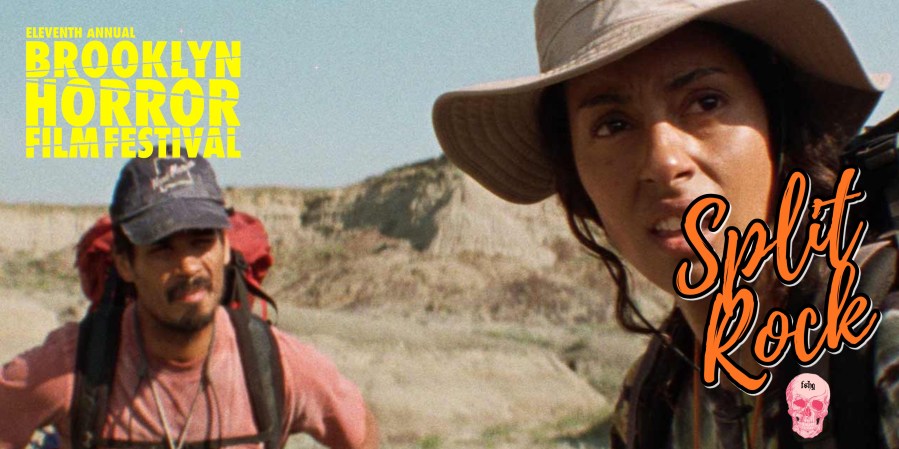
Another fascinating film at 2026’s Brooklyn Horror Film Festival was Ryan Glover’s Split Rock. The story concerns a couple geologists, Lauren (Clark Backo) and Ben (Drew Ray Tanner), who venture into the Canadian Badlands to do field research. They wind up spying a shiny piece of rock that, upon closer inspection, is a piece of magnetite likely “a few billion years old.” The more Lauren closely examines the magnetite, the more it seems to have an effect on her, and soon that effect extends to others. Before long, nobody seems like they’re making it out of the Badlands unscathed.
Split Rock dips between existential and ecological horror, then brings them together while exploring the psychological consequences of humanity mistreating nature. The film makes a psycho-environmental connection through the characters that makes us consider how destroying the Earth literally means destroying ourselves. What Split Rock does well is not only setting a psychological horror within ecological boundaries, it weaves the Earth and humans together with a dose of hard science fiction. It’s a great film in a horrific era during which anxieties about climate change and other connected global issues are at an all-time high.
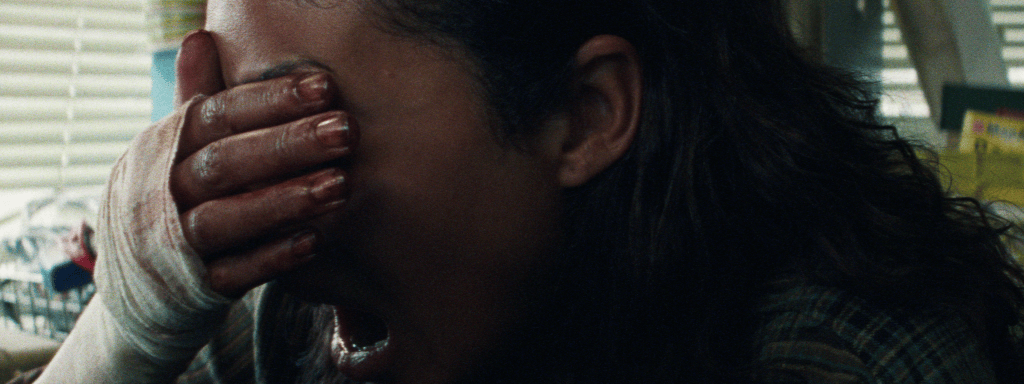
Hard science fiction helps set the table for the degenerative psychological horror that develops throughout Split Rock. After the magnetite’s discovered, Lauren tells Ben and their colleague Sam (Olivia Luccardi) about how “biogenic crystals of magnetite have been found all throughout the human brain.” She elaborates more on how “there’s speculation that the particles might form the physical component, if there is one, of our long–term memory system.” She says excess amounts of magnetite from external sources like industrial air pollution could be a cause of “degenerative neurological problems.” Not only does this hard sci-fi lead to horror, it adds a deeply tragic angle to the story when a specific memory gradually becomes the film’s focus right up to the very final moments.
So many people have no real conception of all the things that come along with our mistreatment of the Earth and the rapidly increasing volatility of climate change. What Split Rock does best perhaps is illustrate how climate change is not the only thing that will affect the living conditions of humans. The more things unearthed by our constant excavating and erosion of the ground beneath our feet, the more we may start to experience psychological and physical effects. The actual theories presented in Split Rock are real theories, albeit part of a developing area of study. Split Rock brings it to life via the horror genre. As things degenerate into bloody terror in the Badlands, the effects of nature’s mistreatment become painfully evident in the psychological and physical wreckage remaining at the end of the film.
Split Rock is haunting and grisly. Glover doesn’t preach despite the film having a clear, strong ecological message at its heart. What sets Split Rock’s horror apart is, in fact, its heart. There’s not only a portrayal of ecological horror due to human hubris, there’s a deeply personal story told between Lauren and Ben that becomes a centrepiece for the film’s terrible tragedy. Split Rock is a prime example of how shrinking existential horror down to the everyday components of life, such as love and affection, allows us to grapple with such large concepts as how continuing to pollute the Earth might mean literally driving the whole world into dementia.

