
Night After Night (2026)
Directed by Josh Lobo
Screenplay by Lobo & Rowan Russell
Starring Scott Poythress, Trace Lysette, AJ Bowen, Johnny Sibilly, & Alexis Louder.
Horror / Science Fiction / Thriller
★★★★ (out of ★★★★★)
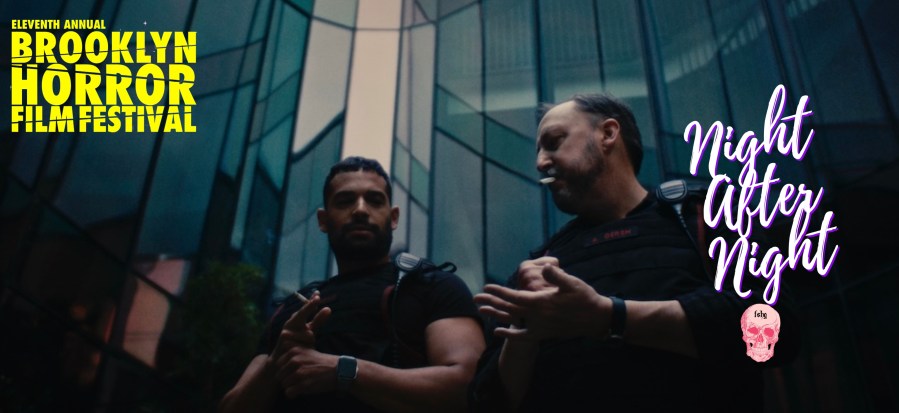
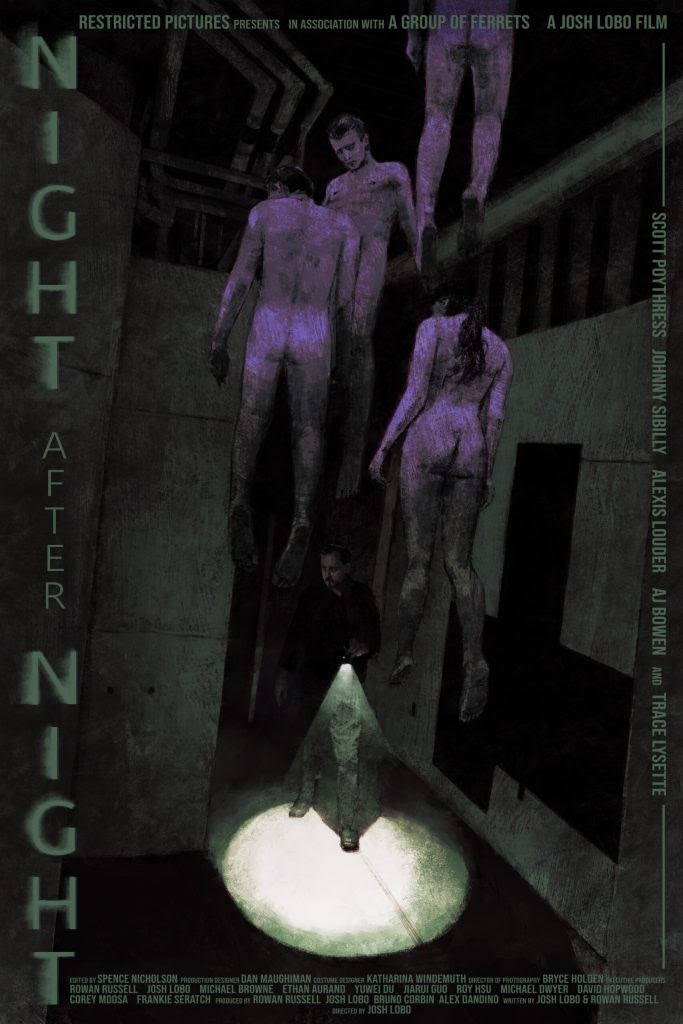
Josh Lobo came to 2026’s Brooklyn Horror Film Festival bearing a weird and wonderful gift, his latest film, Night After Night. The story follows Andy (Scott Poythress), a security guard at a secretive private university. He and his co-worker Willis (Johnny Sibilly) start discussing what’s really going on in the university. Then, they each end up discovering something strange at night on the campus: an odd room downstairs contains a shapeshifting, silent entity. The entity’s existence changes everything going forward.
Although Night After Night is a little too ambiguous for its own good, Lobo’s film is a fascinating riddle that pushes its audience to connect their own dots and create meaning. This essay contends that Night After Night is a genre-bending story that’s all about the difference between men’s desires and those of other people. It seems many keep referring to this film as ‘liminal horror’ but it’s more surreal than anything. Part of Night After Night’s surreal horror is figuring out what it means to you subjectively, as well as determining what figuring all that out means in the end, too.
Meaning is the first focus of Night After Night when we hear Andy’s opening monologue, as he jokingly remarks about the university: “So what if it felt a little closer to Heaven’s Gate than MIT?” Andy and Willis both have their own feelings about the university’s purpose. Andy’s a lot more relaxed about it initially, whereas Willis is suspicious to the very max from the start. “What’s the con?” he asks. Willis rightly tells Andy he doesn’t trust anybody who says they’ve got all the answers. This ties to our decoding of meaning in Night After Night because part of the film’s entire exercise is to determine our own answers. That’s similarly part of the film’s structure, as each character who encounters the entity has a different experience dependant entirely on themselves.
Willis and Andy, though slightly different, meeting the entity, along with their respective actions towards it, are juxtaposed against Janica (Alexis Louder), who runs the university. Janica’s relationship with the entity is largely one that seems more tender than the relationship that Willis and Andy have with it—even though she is keeping the entity and allowing things to happen to it in some kind of grand experiment, but I digress. Willis provides an intense juxtaposition against Janica because he’s immediately predisposed to committing violence against the entity upon meeting it. Janica taunts Willis: “Humans exist to fuck and kill, right?” She also questions him point blank after he violently beats the entity: “What is it you hate so much in the people around you?” The question we’re constantly asked by Night After Night is what would you do if presented with a vulnerable, silent person naked at your feet? Would you offer them help? Or would you exert power over them in some way? Compared to Willis, Andy provides a slight counterpoint in that he wrestles with the violence he, at times, commits against the entity. Andy’s situation is more complicated because he’s already wrestling with a tough family situation and a slightly estranged wife. He may have already done something bad back at home, too. His wife insists he’s “not the monster” he thinks he is, but Andy isn’t willing to let himself off the hook. Andy and Willis are similar men in so many ways but their differences are also clear. Their desires being juxtaposed with Janica’s makes clear the difference between men and women’s desires when presented with a form of pure vulnerability.
Night After Night will more than likely frustrate some viewers because it’s near purposefully difficult to decode. With art, meaning doesn’t always have to be served up in a palatable or immediately and easily consumable presentation. Media literacy across the globe is in a miserable, ugly state in 2026. We should embrace Night After Night for challenging us and not making assumptions about our intelligence or abilities as audiences. Lobo’s given us a bold piece of cinema that urges us to use our critical thinking skills. Any film can and will be read differently by each person who sees it. For me, Night After Night is a story about confronting your darkest inner desires, the kind you never tell anybody about, and either letting them consume you by descending into them or having the strength to choose another path leading upward.

