
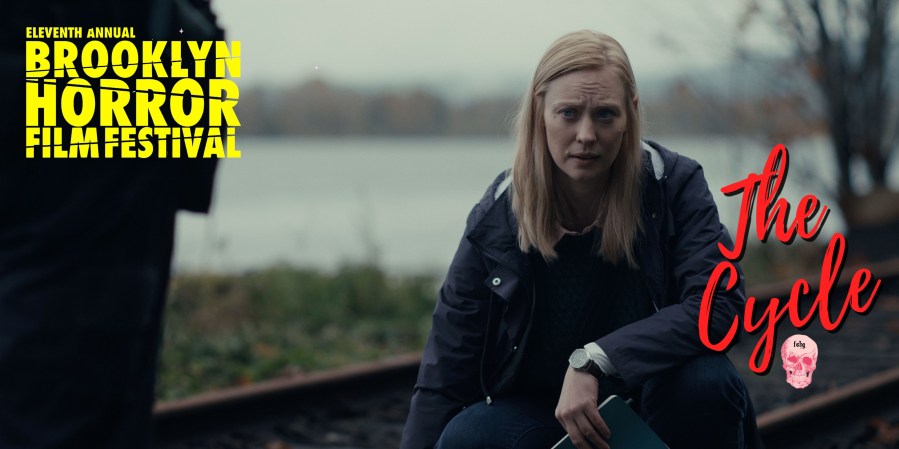
The Cycle (2026)
Directed by Jordan Downey
Screenplay by Downey & Kevin Stewart
Starring Deborah Ann Woll, Jeffrey Donovan, Gretchen Corbett, Will Hochman, Phillip Andre Botello, & Dana Millican.
Horror
★★★★1/2 (out of ★★★★★)
Playing at Brooklyn Horror Film Festival this year, Jordan Downey’s The Cycle tells the story of Dr. Megan Garland (Deborah Ann Woll), whose work on body decomposition calls her not to examine bodies after a gruesome murder scene is discovered, but to deal with the sudden return of her father, or, at least his corpse. Megan’s not seen him in decades since she was a young girl. As she starts to unravel the truth about her father, she uncovers something far more horrifying than family history.
The Cycle is a strong piece of Gothic horror because of how it tells a familiar story in a wholly unique way, as well as how its story deals with a fractured family and the protagonist’s father’s past. There are certain figures in horror, some going all the way back to Gothic literature and even pre-Gothic literature, which have been done to death. The Cycle brilliantly weaves a tale that adds something exciting to one such Gothic figure while wrapped in a heartbreaking tale of a woman attempting to reconcile what she remembers of her painful family history and what’s truth.
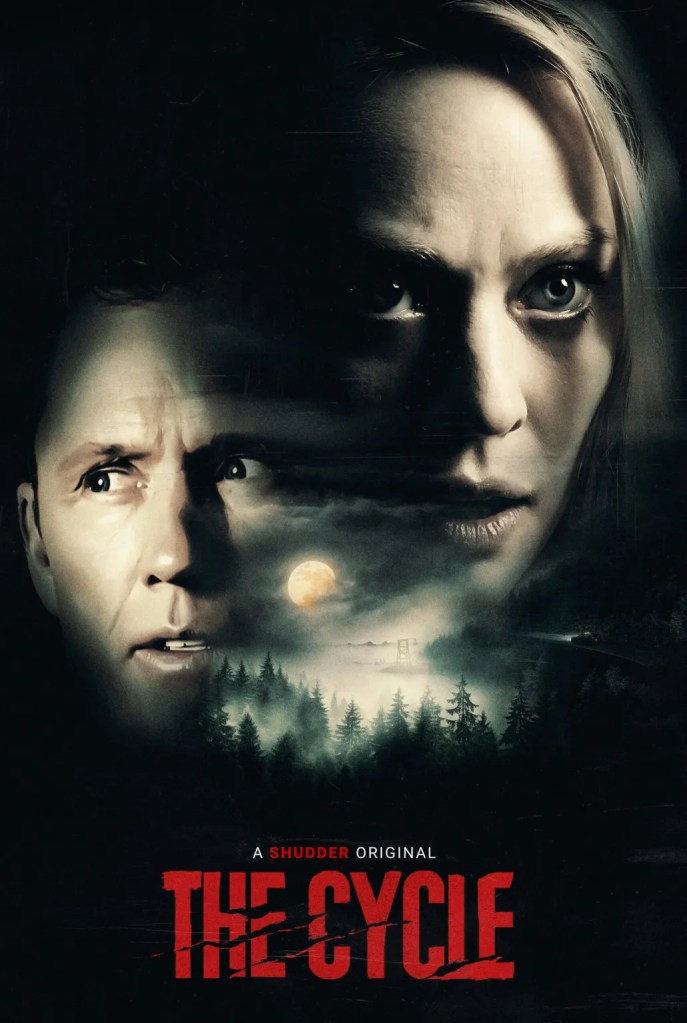
One of the Gothic’s preoccupations over the past several centuries has been the debate over what’s considered monstrous, and The Cycle explores this well through Megan’s father, Peter. Megan grapples with her perception of her father versus what she comes to understand is reality. In the introduction to Classic Readings on Monster Theory: Demonstrare Volume 1, Asa Simon Mittman and Marcus Hensel write: “Monsters do perform important work for us as individuals and communities, policing our boundaries, defining our norms and mores through their inversions and transgressions. Through their bodies, words, and deeds, monsters show us ourselves.” Without spoiling anything, not only does the film’s reveal about Peter’s past uncover the monstrosity at play, Megan also discovers things about her father that force her to confront, and potentially accept, her father’s painfully honest humanity.
The Cycle is classically Gothic in that it deals with dark secrets from the past and a figurative rather than literal haunting. The Gothic typically deals with haunted or traumatised pasts; a centrepiece in Downey’s film. Megan sums up the film’s thematic concerns when she tells a group of people at the body farm how she believes that “every dead body has secrets, they just don’t speak the way you and I do.” The body central to the story is her father, but his body acts in a strange, ghostly sense. Megan’s mother laments that despite being dead, her estranged husband is still “fuckin’ us up.” Even in death, Peter looms over the family, though, in a way, he looms over the entire town where he lived for reasons that become quite obvious later. Without an actual ghost in the film, Peter becomes a ghostly figure haunting Megan and others. In the Gothic, hauntings are aplenty, though don’t be fooled: The Cycle doesn’t traffick in ghostly apparitions, its grisly horrors are a shock of pure flesh and blood.
One character, when referring to Peter’s corpse turning up after being missing for 30-odd years, says: “Something has brought him back.” This is the essence of Gothic distilled: traumatic returning, haunting, and confronting ghosts, no matter how they appear. The Cycle is a great Gothic story about monstrosity, in that monstrosity is often a matter of perspective. It’s also a strong piece of storytelling about the generational effects monstrosity can cause. In between all the terror and corporeal horrors of The Cycle is a potential for Megan to break more than one cycle, so while the film is ultra bleak, there’s a hopefulness deep within that holds a torch amongst the darkness.

