

Sender (2026)
Directed & Written by Russell Goldman
Starring Britt Lower, Rhea Seehorn, David Dastmalchian, & Jamie Lee Curtis.
★★★★ (out of ★★★★★)
DISCLAIMER:
The following essay contains
MINOR SPOILERS!
Turn back lest ye be spoiled.
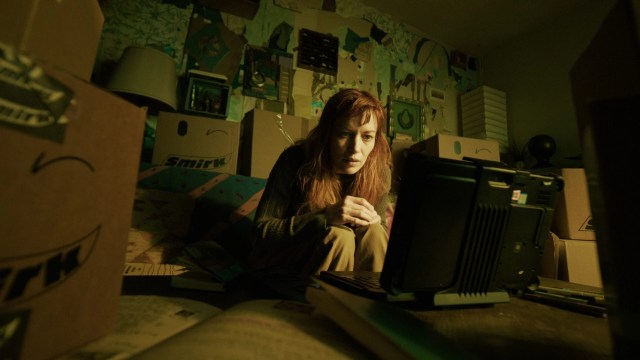
Russell Goldman’s previous short films Burn Out—which I loved when it screened at Fogfest 2024—and Return to Sender—on which his debut feature is based—both dealt with the existential hellscape of capitalism in unique ways. Sender addresses their ideas more thoroughly at feature length. Sender centres around Julia (Britt Lower), an artist struggling with her new life as a recovering alcoholic. Her life gets harder and stranger once packages she didn’t order begin arriving on her doorstep. Even weirder, the products Julia receives are being reviewed online by someone claiming to be her. The more she tries to unravel the mystery behind the packages, the more the threads of her own life loosen.
Goldman’s Sender is equal parts a darkly comic perspective of addiction and a sinister, almost neo-Marxist perspective on how far gone we are due to living through the many terrors of capitalism. Julia’s struggle with sobriety intertwines with her attempt to figure out the origin of all the mysterious packages. It all becomes a surreal tangle. Sender‘s psychological horror is wrapped up in the ways that consumer capitalism has dictated our identities. It’s reduced us to rubble as people: we are no longer ourselves; we’re online profiles, we’re product consumers and product reviewers, we’re busy worker bees providing products to other product consumers. We don’t even need alcohol or drugs to fuel addiction anymore because consumption under capitalism has become perhaps the biggest addiction of all, just as Julia seems to trade one addiction for another. Sender is a grim depiction of how the self is slipping away into algorithms, though it doesn’t suggest all hope is lost; we can find the self again, we just have to be willing to do the work to get back to ourselves.

“Our security system is safe. Your data is safe. You are safe.”
Capitalism is the key to climbing out of addiction in Sender, except it is, itself, an addiction, especially via consumer capitalism, the very thing on display throughout the film. First, there are obviously all the packages sent to Julia, as well as the reviews being posted in Julia’s name by someone other than herself. The mysterious package sender becomes a great metaphor for the algorithm that now dictates the online experience of every single person online, no matter how digitally free we believe ourselves to be. The mysterious person can be read as a manifestation of the all-encompassing nature of the internet and social media’s algorithms, pulling us into its monotonous spiral to the point we split into two selves, the offline self and the online self; this plays out in Julia’s uncanny experience of seeing the reviews posted online as if by her own hand, at times wondering if she’s just fallen off the wagon and blacked out for episodes that include online shopping. Second, there are the energy drinks we see Julia constantly downing; specifically, Celsius energy drinks. For Julia, one addictive liquid replaces the previous addictive liquid, and of course it’s a well-known brand. The prominence of the cans and brand name suggests Celsius might have even paid for product placement; if so, metafiction on a devious level. Finally, there’s Julia’s living arrangement and deliveryman Charlie (David Dastmalchian) sleeping where he works. Julia’s sister treats the living arrangement as an “experiment” after Julia going sober, so it’s as if Julia’s reduced to a specimen living in a life-sized tank thanks to her sister’s real-estate job. Y’know, because a mortgage is definitely the best way to keep yourself sober. Charlie’s so invested in his work he often sleeps in his work van with a little makeshift bed to use because peoples’ demands of consumption are so great that he has no time to commute between home and work so he collapses the two into one unit.
An underlying theme in Sender is the agony of capitalism under which we all live, in some shape or form. This theme is expressed best via a reference Whitney (Rhea Seehorn) makes to Samuel Taylor Coleridge’s The Rime of the Ancient Mariner, and the lines that stick with Julia throughout the film: “The many men, so beautiful!/ And they all dead die lie And a thousand thousand slimy things/ Lived on; and so did I.” We are all amongst the slimy things, out here surviving like Coleridge’s Mariner, though capitalism has taken so many already, and continues to take them; it may not be a glorious existence to simply be surviving, but hey, at least we’re alive.
Sender goes beyond dark comedy into psychological horror, most specifically due to the subplot with Jamie Lee Curtis’s character Lisa Barr, another woman who received packages she never ordered, whose story is tragic. We learn increasingly shocking, even gruesome facts about Lisa’s story; that is, if we believe everything we see is entirely real, one of the best, surreal qualities about Goldman’s film. Without ruining the image, Lisa’s own flesh—and blood—is turned into a nasty metaphor relaying capitalism’s infiltration of the self, as identity becomes no more real than a drawn-on doll’s face. A recurring piece of a product sent to Lisa makes its way into Julia’s life, too, albeit this could be a piece of the surreal again. It becomes increasingly difficult to distinguish between Julia’s reality, memory, and paranoid fantasy the more the film wears on. If the piece of product’s presence is real, it’s actually the most sinister part of the entire story. Seeing it enter Julia’s life, surreal element or not, is an image that speaks to the ever-present consumerism lurking in our daily shared existence, and consumerism’s sharp, dangerous barbs.
Goldman’s Sender becomes a blur of Kafkaesque madness for Julia after a while, yet the end returns to a strangely human place. What’s clear is that capitalism has gotten in the way of us knowing ourselves. Julia’s story is a fantastic figurative vision of twenty-first century living where we’re perpetually caught between online and offline lives, a process that is, more and more all the time, mediated by capitalism. An interesting, revealing line comes to us when Julia thinks the package sender might be someone she thinks she had sex with, and after she confronts him, the man assumes she’s been drinking: “You don‘t have to live like this,” he says with pity in his voice and eyes. The saddest part is Julia isn’t drunk at this point, she’s totally sober, but the terrors of capitalism, specifically digital capitalism, have rendered her to almost the same state as being drunk since she comes off belligerent and somewhat incoherent. Here lies Sender‘s coherent message under all its delightfully contained madness: capitalism drives some of us to drink, it drives us to consume in so many varied ways that are unhealthy, it drives us to be violent with ourselves—through both figurative and literal forms of violence—and, most of all, it’s driving all of us crazy. Despite everything, Goldman’s film isn’t resigned to hopelessness in the face of capitalism. How does Julia get by? The care she discovers in other people. This is Sender‘s reflection of our own reality since the only way we’ll ever survive capitalism is by coming together.

