
The Saviors (2026)
Directed by Kevin Hamedani
Screenplay by Hamedani & Travis Betz
Starring Adam Scott, Danielle Deadwyler, Theo Rossi, Nazanin Boniadi, Kate Berlant, & Daveed Diggs.
★★★★ (out of ★★★★★)
DISCLAIMER:
The following essay contains
VERY MINOR SPOILERS!
Avert thine eyes, or be spoilt forever.
Kevin Hamedani’s The Saviors is the story of soon-to-be-divorced Kim (Danielle Deadwyler) and Sean (Adam Scott), a suburban couple who rent out their garage guesthouse to brother-sister pair Amir (Theo Rossi) and Jahan (Nazanin Boniadi). Fairly quickly, the seemingly liberal Sean begins to believe that Amir and Jahan are not who they claim to be, and that something sinister is afoot. There’s also a big upcoming visit by the current President of the United States to a nearby cemetery and the promise of protests/counter protests by all sorts of groups. The neighbourhood and the city are in chaos. Eventually, Kim starts to wonder if Sean is onto something, and the decisions they make in an attempt to uncover the truth have devastating ramifications.
In 2026, America is living through a rise of fascism, no matter what fantasy detractors of this opinion choose to believe, and Hamedani’s film fits well in that climate. Though, truthfully, The Saviors could’ve been released anytime after 9/11 and it’d sadly feel deeply relevant to the peak Culture War America that crystalised in a matter of months after those planes hit the Towers. What’s most relevant to 2026 America in The Saviors is how much perspective matters. More importantly, the film addresses how perspective can be manipulated by anybody with a willingness to believe in their own perspective, something Hamedani proves in the way his and Travis Betz’s story gets told visually; Hamedani sits us directly in Kim and Sean’s perspective until the very end, after which we get glimpses of the truth from another perspective. What’s really compelling is how Hamedani employs a genre film twist in the finale to heighten the film’s atmosphere, simultaneously imbuing the story with a universal humanity that goes beyond race, creed, and nationality.
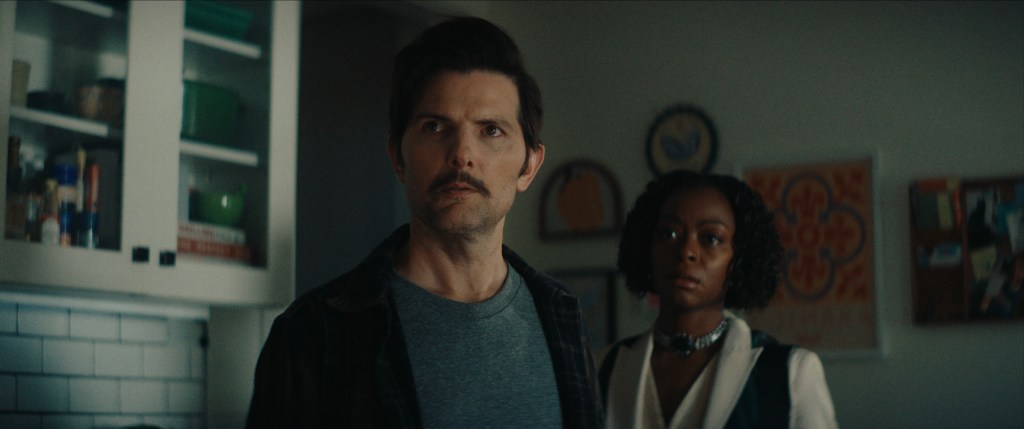
The Saviors confronts what I’d call the liberal facade, both white and Black: Sean’s the liberal standout in his family; Kim doesn’t take that much convincing to come around and drop her own facade as a liberal woman, following along with her husband’s paranoia and even entertaining, if somewhat inadvertently, his sister’s more outward bigotry. The most prominent display of the liberal facade is when we get a glimpse of Sean with his family in their ignorant white bliss. His mother and father are happy to subscribe to literature from a group called Patriot Dawn, whom Sean explains bluntly is “a neo–Nazi right–wing” group. His dad uses a well-known quote in a wildly stupid way when he says: “If not us, then who?” This actually traces as far back as to Hillel the Elder, but it was famously used by American civil rights activist John Lewis, and, maybe most relevant to the film’s usage, Ronald Reagan once bent it to his own wretched purpose, too. Sean’s sister Cleo (Kate Berlant) is another typical MAGAt, spouting off words like “libtards” and hilariously pontificating that so-called conservatives are “the punks” now. These are some examples of an excruciating realism in The Saviors that lie beneath its genre-film elements.
While Sean plays dissenting liberal within his own family and tries to lecture them on their respective behaviours, he so easily subscribes to Islamophobia for the sole reason that he finds Amir and Jahan’s behaviour odd by white American standards. At one point he embarrassingly trips over his own words, inviting Amir to a backyard barbecue where he says Amir and Jahan can just be “refugees” and “not fake Americans.” Supposedly harmless slips of language on Sean’s part soon give way to both Sean and Kim using the same phrases as Cleo, like “sleeper cells,” in connection with Amir and Jahan, each revealing how Islamophobia knows no racial borders, especially not in America.
“It‘s a great step forward for humanity
when we let strangers sleep amongst us.”
Hamedani does a great job portraying how America’s surveillance culture has become part of daily life, not just an arm of technology. The American government’s response to 9/11 embedded surveillance into the fabric of American culture going forward. The US doesn’t have near the same amount of CCTV surveillance as somewhere like Britain, but it’s turned neighbourhoods into suburban Panopticons across the country. What’s so interesting in this respect about The Saviors is that, in the end, the film reveals it’s often people who are overly angry about something who are actually the ones doing something wrong. This feels all too real because we see this with MAGA nearly every single week, as their fear mongering comes home to roost. For instance, MAGA supporters consistently claim drag queens and trans folks are paedophiles but every few news cycles another MAGAt is arrested for possession of child sexual abuse material, and they call Muslims terrorists but they support Israel committing acts of terrorism in Palestine and other parts of the world. Did we go too deep? Well, The Saviors invites this length of critical thinking about the deceit at the heart of American nationalism. Don’t blame me.
The Saviors asks bigger questions about prejudice and racism than only what happens when individuals perpetuate this kind of behaviour, it asks what the ramifications are for the world itself. How much hatred of the Other will America allow and how much will it sacrifice in the name of that hatred? What happens when it’s not buildings crumbling but the entire nation, or, worse, the entire world? And what happens when America itself becomes the bomb that destroys itself/it all? “Crickets don‘t sing in a world with no songs” and nobody survives in a country that continues to run on hate. Hamedani’s film is smart, upsetting, and, with any hope, should hit American audiences a little too close for comfort.

