

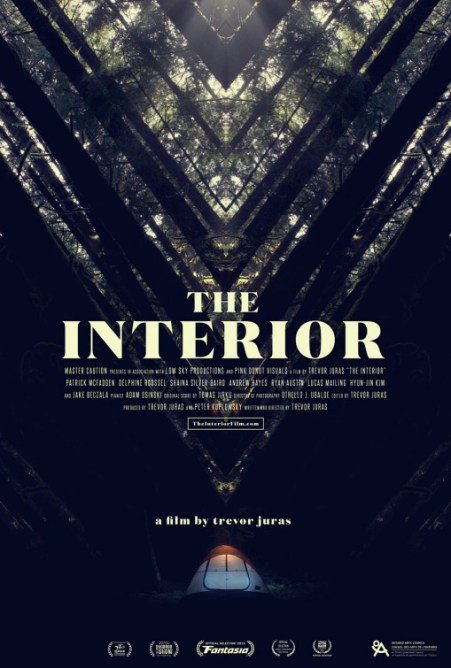
The Interior. 2015. Directed & Written by Trevor Juras.
Starring Patrick McFadden, Jake Beczala, Andrew Hayes, Delphine Roussel, Ryan Austin, Lucas Mailing, & Shaina Silver-Baird.
Low Sky Productions/Master Caution Pictures.
Not Rated. 80 minutes.
Comedy/Drama/Horror/Mystery
★★
 Indie film is great because that’s where a lot of interesting, cutting edge, gritty, sometimes outrageous and over-the-top ideas come out best. Because there’s often not as much riding on an independent picture as with something big out of Hollywood, small time filmmakers take risks trying to create something innovative and interesting with what they have at their disposal.
Director and writer Trevor Juras’ The Interior has all the right DNA necessary for an indie flick to be captivating. There’s picturesque scenery making the steady and measured cinematography look damn beautiful. The lead actor Patrick McFadden does his best with the material provided, which mostly involves emotion once his character winds up by himself in the middle of nowhere in miles of thick forest.
But along the way, Juras doesn’t capitalise on the solid elements of his screenplay, nor does he do anything much unique with the look of the film. With such natural beauty at hand there could’ve been better visuals put into play, other than the nice stuff we see as McFadden takes us through the wilderness. Instead there’s nothing you wouldn’t find in a found footage film these days. It’s a shame because there are glimpses of excitement. They’re buried under a pile of missed opportunity.
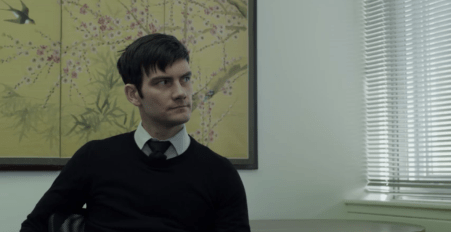 “My friend said I should cut out gluten?!”
Ah, if only it were that easy. James (McFadden) is a disaffected young man. He’s repressed, like Kevin Spacey’s Lester Burnham, only younger and living in the 21st-century, fantasising in the company bathroom about telling his boss to fuck off, show up baked and bringing half-smoked joints to his doctor’s appointment. The classical music employed throughout the first few scenes involving James at the office, even though we do get slight bits of dialogue, makes this portion of the film feel like a silent comedy. We watch the hapless young professional navigating a near slapstick sequence with his jagoff boss who loves pastries and talking on the phone. What this early part of the screenplay does is setup James’ disillusionment with his yuppie lifestyle, or the one blooming as he listlessly wanders through the days.
This film is all about the personal journey into our own interior. As we’ve seen in trope form throughout many movies and television shows, the personal journey inward is symbolised in the physical journey outward. Initially, James rejects the typical office job wanting instead to do actual physical labour. He’s dying – begging – to be reconnected with himself and the world around him. So, he heads off without much thought into the British Columbia forest, which takes us deep into wonderful locations of Salt Spring Island on the far West Coast of Canada. Along with this is an exploration of self.
James encounters a huge problem due to the fact that if you’re alone in the woods, you’re still alone with yourself. And if it was yourself you couldn’t live with all along – not the city lifestyle and all those suffocating societal elements – then being out amongst the stark wilderness with only trees and your inner thoughts for company, paranoia can set in quick, fast. And in reality, paranoia is the least of the worries, as James so eagerly discovers.

 “Youth is a currency”
Ultimately, I feel that Juras means to say, in the end, that you either figure out your place, or nature takes over. You live, you die. Therefore: figure yourself out; if not, nature doesn’t cease and your time will come. Whether you like it or not. Nature simply carries on, oblivious to our existence (the sentiment Juras seems to illustrate in his choice of final shots). Unfortunately for him, there’s nothing to fill the massive void which lingers throughout most of the film. I’m fine with little to no dialogue, meagre action. That doesn’t bother me; I’m an arthouse lover, too. That being said, Juras doesn’t fill the lack of action (in any shape or form) with tension or suspense. There’s barely any mystery. We gain a sense of James getting lost in the woods and further lost in his own head. Outside one or two moments in the dark, following his tiny flashlight beam, nothing amounts to tense in the least. Definitely nowhere near the level necessary for the journey to be compelling. At least there’s nice classical music to float us along, as we trail behind James traipsing through the lonely forest.
The best Juras does is examine the old adage – you can take the boy out of the city, but you can’t take the city out of the boy. Hoping to get back to nature, James cannot truly let go of his city-learned distrust, his feeling of primitive competition with the humans next to him within the concrete jungle of the big city. He sees and hears intruders – the man in the red jacket – but are these all figments of his imagination? There’s no evidence that any of it is real, as well as no full proof they’re only apparitions. When it all comes down, James is an example of the confusion in human beings once we move outside of our natural habitat, start living more disconnected from real life in the cities.
 Juras had his heart in the right place. The Interior is only worth about 2 stars out of 5, and maybe that’s even pushing it. Still, I can’t help but feel there are enjoyable pieces to the screenplay. Perhaps Juras couldn’t execute them properly and grab hold of what exact themes he wanted to convey.
Don’t go into this one expecting horror. At best this is psychological horror, although there’s still not enough to really categorise it as such. It’s an in-depth character study – a flawed one – looking at how city v. rural works in the modern day. This film could’ve used more beef to the screenplay. I love sparse writing if it serves a point and works towards some purpose. Otherwise it’s just trim for the sake of being trim. Juras needed to flesh this out further, past 80 minutes, and add a few extra scenes to keep the pace enticing.
What you get is a mysterious little picture that doesn’t hit most of its marks. You won’t be enthralled from beginning to end. You may check your watch once or twice. The Interior tries and tries again, never quite getting past spinning its wheels. Here’s to hoping Juras gets better on the next project.
 Father Son Holy Gore